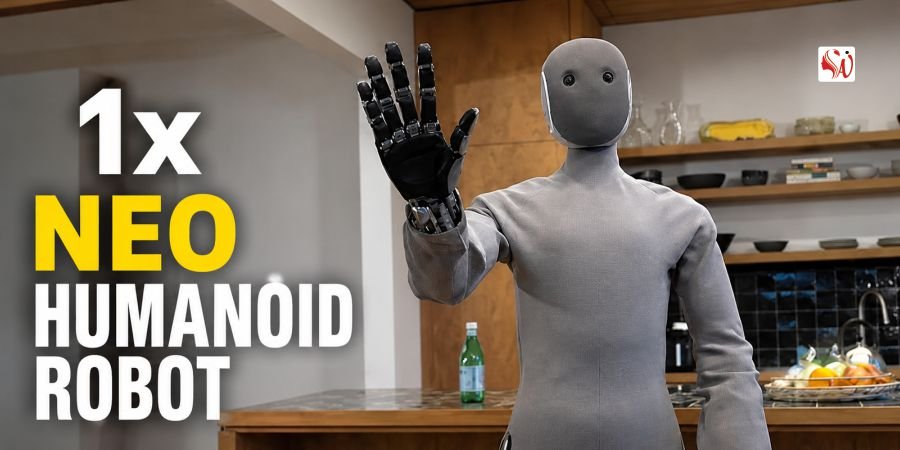
The fact that the 1x neo humanoid robot has human-like abilities but is not designed to be fully autonomous, is perhaps the most significant detail about the device. The fact that it can call a human expert for assistance when faced with a difficult task opens up a new level of integration between machines and human skills, as well as raises a vital question: when does the AI robot cease to be an independent device and turn into a machine operated by a human worker?
The question needs attention, because NEO is preparing to operate in the unpredictable realm of human environment. Unlike factories, homes are filled with pets, children, interesting objects, fragile things, and the different layouts that represent a continuous obstacle for any robot. The NEO product is intended for learning in specific environments. Its current model is equipped with Redwood AI system that allows the robot to repeat actions and tasks at home.
The Idea Behind Human-in-the-Loop Robotics
A distinct perspective regarding the functioning of robots is manifested in the 1x neo humanoid robot. Rather than wait for an AI model that is capable of working in any household circumstance, 1X has developed a strategy of coping with the unknown. Each time NEO faces household chores that it cannot carry out successfully, the owner can book an Expert Mode session, during which the robot will get help from a 1X employee remotely who will learn how to operate correctly during that task.
Here it is crucial to point out that human assistance does not imply controlling all the robot’s movements. The more general meaning is focused on teaching and supervising, while the ratio between the robot and its operator depends on the task performed. This fact makes the whole process particularly intriguing when speaking about AI development because of its interesting capacity to replicate real-life home situations.
Where Artificial Intelligence Ends
The 1x neo humanoid robot is particularly interesting in performing a task that may be similar in theory but different in practice. For instance, if you ask it to put away laundry, but the clothes are positioned differently than what it has encountered before. Traditional computer programs would probably fail to accomplish such task since their set of instructions does not allow for enough flexibility. A general robot must understand the context of the situation, know the goal and determine the way it should be manipulating previously unknown objects.
NEO’s Artificial Intelligence is able to do most of it on its own. But when it comes to the limits of its capability, there comes a human being who can offer even more intelligence. The human can see what NEO sees and help it overcome an unfamiliar situation by teaching it how to perform this task in practice.
This is why judging the ability of the 1x neo humanoid robot solely based on whether it can perform each task independently. Instead, it is more important to examine how much time it takes for the robot to cease requiring help with certain tasks.
The Privacy Problem Is Harder to Ignore
While listing one of its innovative features, the 1x neo humanoid robot is generating some unprecedented levels of anxiety among users. This is primarily because, in order to operate as a household robot, it has to use cameras, microphones, and be aware of its environment. The biggest justification for this concern could be the involvement of human experts in the process of operating the 1x robot.
This is one aspect which has already made news about NEO. 1X was quoted in earlier tests saying that customers have full control over when their employees can see the surroundings of the robot for purposes such as auditing or tele-operation. TechCrunch has mentioned plans of testing NEO Gamma in hundreds of houses and is already stressing on the privacy concerns with regard to collecting the camera and microphone data from homes.
Currently, the NEO product page makes the human involvement in the process even clearer by stating that the owners can schedule an Expert whenever they require assistance for a task that the robot has no knowledge about.
The Human May Be Part of the Product
The key takeaway from the 1x neo humanoid robot might be the realization that autonomy is not a binary function. Rather, it exists on a continuum. The NEO can carry out certain functions autonomously but can also get assistance in cases where it is unfamiliar with how to perform the task and learn from those experiences in order to improve in the future.
This results in a distinction between human assistance functioning as a permanent substitute to machine learning and being more akin to a scaffolding around the system that has not yet matured. Ideally, the scaffolding will be reduced in use over time.
The 1x neo humanoid robot has wider implications for the field robotics as it implies the process of achieving autonomy to take longer than one might expect.
How far 1X can reduce the human role may eventually determine the future of the 1X neo humanoid robot. The model may be a viable path toward truly capable house robots if today’s Expert Mode turns into tomorrow’s sporadic safety net rather than tomorrow’s covert workforce. If a significant portion of routine tasks still require human participation, NEO will be better understood as an advanced teleoperation system with AI support.