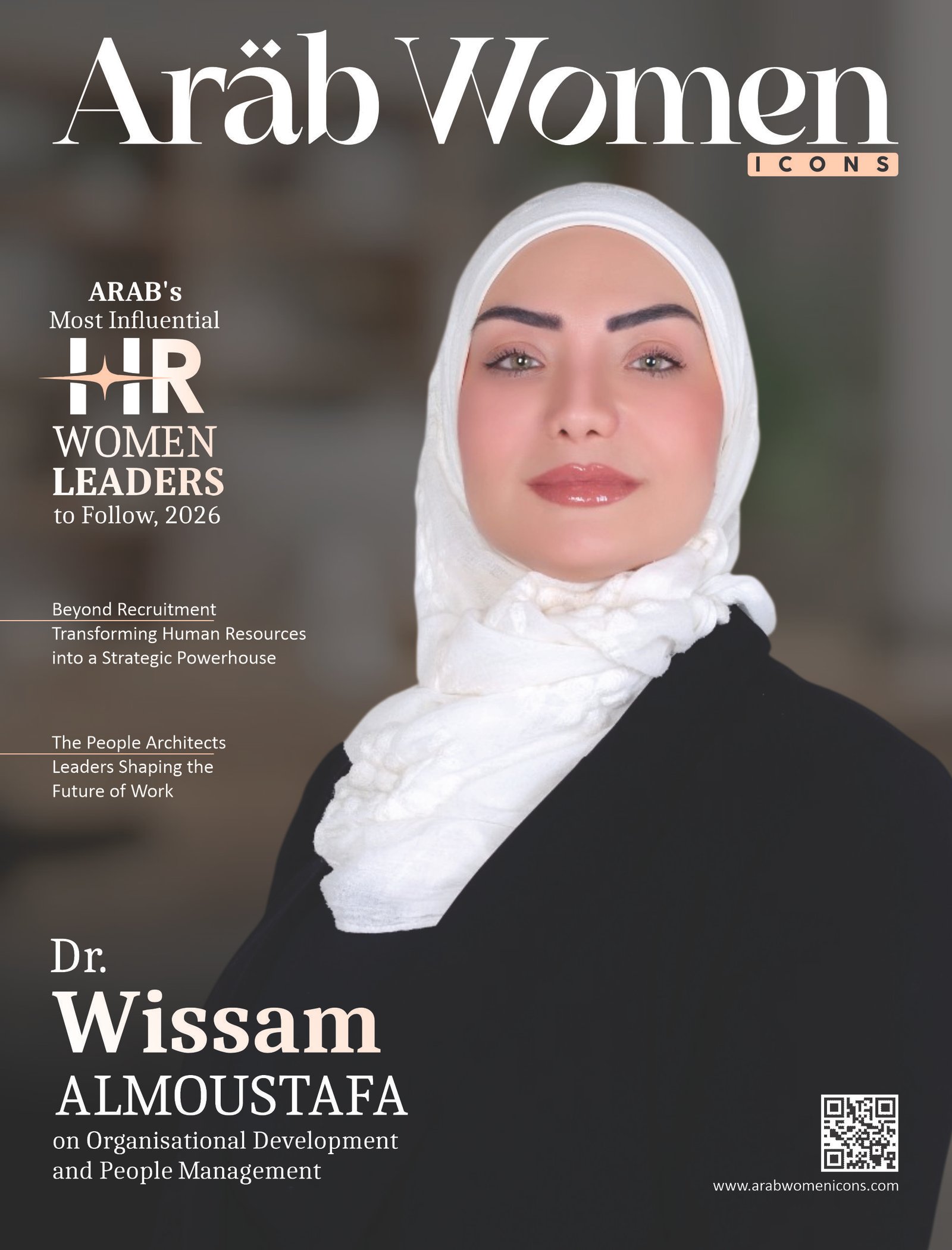
Dr. Wissam Almoustafa approaches organisational performance through the decisions that shape working life: how responsibilities are assigned, how people are selected and developed, and how leaders exercise authority. As a Senior Organisational Development & People Management Expert, she connects these decisions to the institution’s ability to deliver its strategy.
Her experience spans banking, corporate environments and government institutions, including national workforce development in the Gulf. Dr. Almoustafa’s work encompasses talent acquisition management, performance management and instructional design, alongside managing large taskforces and coordinating projects through the stages preceding operational launch.
Across these settings, her professional focus has remained consistent: understanding what enables people to contribute and what organisations must change to support that contribution. In this conversation, she explains how that perspective informs her approach to organisational diagnosis, leadership and workforce development, and why fairness belongs within the practical responsibilities of management.
What first drew you to organisational studies and HR leadership?
I wanted to understand why organisations with similar resources could achieve such different results. My early experience in banking, learning and organisational development drew my attention to how work was structured and how leaders made decisions. People’s contribution depended partly on whether their responsibilities were clear and whether they had the authority and support to fulfil them.
That shaped the direction of my career. I became interested in the relationship between individual potential and the conditions in which people work. When someone is struggling, I want to understand both their capability and the demands the organisation is placing on them.
My conviction has remained consistent: people should have a fair opportunity to develop and progress. Institutions have a responsibility to make that opportunity credible through the way they manage work, assess contribution and make decisions about careers.
How do you assess HR’s strategic contribution to an organisation, particularly when it comes to workforce decisions, capability development, recruitment, and succession planning?
I assess HR’s contribution through the decisions it helps the organisation make. A recruitment decision affects the skills available to a team. A development decision affects who becomes ready for greater responsibility. A succession decision affects how well the institution can continue when a leader leaves. These choices need to reinforce one another.
At senior level, understanding the organisation’s priorities is essential. If expansion requires capabilities that are scarce internally, HR must help leaders assess whether to develop, recruit or redeploy people, and what each option means for execution.
At senior level, understanding the organisation’s priorities is essential. If expansion requires capabilities that are scarce internally, HR must help leaders assess whether to develop, recruit or redeploy people, and what each option means for execution.
That requires a working knowledge of the operating model, resources and business constraints. It also requires the confidence to question assumptions. A request for additional headcount, for example, deserves examination of workload and role design before recruitment begins. Strategic influence grows when that examination helps leaders make a better decision.
How do you assess whether an organisation’s structure and culture support its objectives?
I start with how the organisation actually works. Its formal structure should explain who is responsible for an outcome, who can make the relevant decisions and where coordination is required. I then compare that design with the experience of delivering the work.
Repeated escalation can reveal unclear authority. Overlapping responsibilities can leave an important task without an accountable owner. A specialist may be available but unable to contribute because the process does no nvolve them at the right stage. These are different problems and need different responses.
Culture becomes visible in how leaders handle such situations. I pay attention to whether concerns can be raised, whether disagreement is examined fairly and how management responds when performance falls short. Those behaviours show how the institution’s stated values operate in practice.
The assessment should lead to a specific explanation of what needs to change. Redrawing reporting lines is useful only when it addresses the underlying problem and improves the ability to deliver.
What distinguishes a candidate who meets current requirements from someone who can contribute to the organisation’s future?
I look beyond the description of a previous role to the candidate’s actual contribution. What were they responsible for? What decisions did they make? How did they respond when conditions changed or an approach failed? Those questions help establish the substance behind a career narrative.
For senior and critical positions, I also examine leadership maturity, learning agility and the ability to develop others. A strong individual performer may need further development before taking responsibility for a team. Equally, experience in a particular setting does not automatically establish readiness for a different one.
I value candidates who understand how their decisions affect the wider institution. Their potential is more convincing when they can explain the evidence they considered, the competing demands they faced and what they would approach differently now. Selection should give appropriate weight to present competence and the capacity to assume changing responsibilities.
What makes performance management useful to employees and leadership?
It should help both parties understand what is expected, what is happening and what needs attention. Employees need expectations that relate to their actual responsibilities.
Managers need evidence that allows them to discuss contribution fairly and intervene while improvement is still possible.
The diagnosis matters. Similar results can have different causes. Repeated delays might reflect a capability gap, unrealistic workload or an approval process outside the employee’s control. The manager must establish which explanation is supported before deciding on the response.
Consistent assessment also requires calibration: managers should compare the evidence behind their judgements and resolve differences in how standards are applied. This gives decisions about development, recognition and progression a stronger basis.
I would judge a performance system by the quality of the action it enables. A completed review should establish clear expectations and agreed actions for improvement. Its value becomes apparent when follow-up discussions show whether those agreed actions have improved performance.
How do you design learning that addresses an actual organisational need?
The first question is what people need to do differently. Once that is clear, I examine whether the obstacle is a lack of knowledge or skill. Training is appropriate when learning can address the identified gap. It will have limited effect if the real problem is an unclear role, an unsuitable process or inadequate tools.
I build the learning experience around the conditions in which the capability will be used. Participants need relevant practice and feedback, and their managers need to understand how to support application afterwards.
The assessment should reflect the work. If the requirement is to exercise judgement, recalling information alone will not establish competence. People need an opportunity to apply what they have learned and explain their decisions.
I return to the original performance requirement when evaluating the intervention. Programme completion confirms participation in the planned learning activities. Evidence from practice establishes whether participants can demonstrate the required capability.
How should organisations decide which capabilities their workforce needs next?
Begin with the work that is likely to change. Strategy, technology and regulation can alter the tasks people perform and the expertise the institution requires. That analysis should precede the selection of learning programmes.
Existing skills then provide a starting point. Some employees may be able to move into related roles with targeted development; other requirements may call for recruitment or external expertise. The organisation needs to consider the time available, the feasibility of development and the consequences of leaving a gap unresolved.
Workforce planning should consider several plausible scenarios. A single forecast can create false confidence, particularly when technology or demand is changing. Skills information becomes useful when it helps leaders compare their options and adjust investment.
For employees, reskilling should create realistic opportunities. They should understand how new capability connects to work or progression. Managers also need to support movement between teams where appropriate. Alearning programme cannot fulfil a workforce strategy if opportunities to use the resulting skills remain closed.
You have managed taskforces and worked on projects before operations began. How do you align different functions under pressure?
Such work requires close attention to readiness and dependencies. Different teams may be progressing against their own plans while a decision or resource needed by another function remains unresolved. I focus on making those connections visible and clarifying who is responsible for resolving them.
People need a shared understanding of the outcome and the decisions required to reach it. When priorities compete, the discussion should address the implications for delivery, including the risks of proceeding or waiting.
Professional differences can improve that discussion. Finance, operations and people specialists may recognise different consequences of the same proposal. The leader’s responsibility is to ensure that those perspectives are heard and that a decision follows.
I do not equate agreement with effectiveness. Teams can disagree constructively and still execute well when authority is clear, concerns receive proper consideration and everyone understands the decision. Under time pressure, that clarity is especially valuable.
Which principles remain relevant across banking, corporate and government settings?
The purpose of the institution determines what success means. Banking brings particular regulatory and risk responsibilities. Companies must respond to commercial performance and market conditions. Government institutions are accountable for public value and policy delivery.
My experience across these environments has reinforced the importance of understanding that purpose before recommending organisational changes. Practices should fit the institution’s mandate and operating conditions.
Some requirements remain consistent: people need clear responsibilities, leaders need appropriate authority, and important decisions need an accountable owner. Continuity also deserves attention before the loss of a key person becomes an operational problem.
Fairness is a governance responsibility across sectors. Decisions about grading, advancement and development should have an understandable basis that can withstand scrutiny. Different circumstances may justify different decisions, but the criteria should remain clear and consistently applied.
How do you help employees engage with major organisational change?
Employees need an explanation they can relate to their work. Why is the organisation changing? What will happen to their responsibilities? How will decisions be made, and what support will they receive? These questions deserve practical answers throughout implementation.
Managers have a central role because they translate institutional decisions into daily expectations. If leadership messages and managerial behaviour conflict, employees are left to interpret the change for themselves. Alignment therefore has to be maintained through implementation.
I take resistance seriously as information. It may reveal uncertainty, missing capabilities or practical weaknesses in the proposed arrangements. Understanding the concern helps determine whether the response should be clarification, support or a change in the implementation approach.
Progress becomes visible when new ways of working are used consistently and support the intended results. Communication activity is part of that process. It should be assessed alongside whether employees can perform effectively within the new arrangements.
What advice would you give HR professionals who want to become strategic organisational leaders?
Learn how the institution operates beyond your own function. Understand how it creates value, where its resources are committed and how its major risks are managed. This gives your technical expertise a context that senior leaders recognise.
Develop the habit of examining the initial diagnosis. An issue described as low motivation may involve conflicting objectives or poor management. Your responsibility is to distinguish the likely causes and explain why your proposed response fits the evidence.
Also consider who will experience the consequences of your advice. Changes to structure, performance expectations or succession arrangements affect careers and trust. The people involved deserve a fair process and an honest explanation.
Credibility develops through the quality of your judgement. Be clear about what you know, where uncertainty remains and what choices are available. Advice becomes valuable when leaders can use it to make a responsible decision.
What does meaningful support for women in leadership involve?
For me, it means ensuring that capable women can take on work with genuine strategic significance and the authority to influence decisions. Appointment to a leadership role should be accompanied by the resources and support required to deliver.
Development opportunities matter well before an appointment is made. Institutions should examine who receives demanding assignments, exposure to senior decision makers and sponsorship from leaders who actively support their advancement. These opportunities help determine who is considered ready when a position becomes available.
Fair progression requires clear criteria and attention to how they are applied. I believe women should be able to demonstrate their capabilities through substantive responsibilities and receive appropriate recognition for their contribution. My interest is in the conditions that allow them to exercise leadership fully and achieve results commensurate with their expertise.
How will technology, particularly artificial intelligence, influence organisational development and the way work is designed?
They will require leaders to examine how work is designed and where responsibility sits as tasks change. With artificial intelligence, the decision extends beyond choosing a technology. The organisation must determine where human judgement remains essential, how decisions are reviewed and who is accountable for the outcome.
These choices affect roles and development priorities. Employees need to understand changing expectations and have credible opportunities to prepare for them. Institutions must also preserve knowledge that remains important as work is redistributed.
Workforce intelligence can support those decisions by connecting business priorities and technology plans with internal skills information and labour market evidence. The purpose is to recognise emerging gaps early enough to act.
I would assess progress through the organisation’s ability to make sound decisions and deliver its responsibilities. Technology should strengthen that ability while people retain the knowledge, support and authority needed to contribute. That is where organisational development and people management must remain closely connected.