Technology companies often grow across borders before their legal structures have had time to catch up. Intellectual property, licensing, data, contracts, and regulatory requirements all have to work together if a business is to operate internationally without creating problems that surface later. Good legal work in this space is therefore not only about interpreting rules. It is about understanding how a technology business is built and making sure its legal architecture can support where the company intends to go.
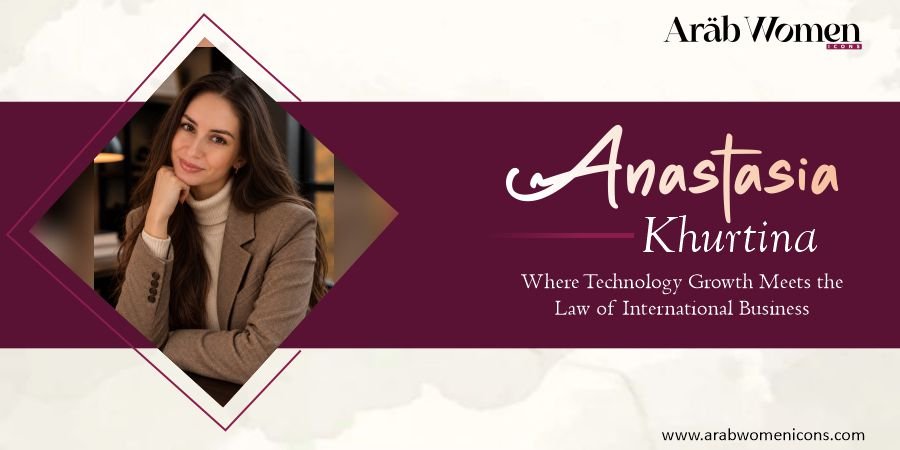
Anastasia Khurtina, Corporate Lawyer specializing in IP, AI and technology law, and cross-border compliance, has built her career around that intersection. As the Founder of Golden Fish and a co-founder and legal lead of InterMIND, an AI technology platform, she focuses on the legal architecture of technology companies, including IP ownership, licence compliance, cross-border structuring, and the regulatory frameworks required for international operations. She holds an LL.M with honours, is a certified Sanctions Compliance Officer, and is a published researcher in digital intellectual property and civil law.
Her perspective is shaped by an unusual career spent largely inside technology companies rather than advising them from the outside. She has worked as Chief Legal Officer and Deputy CEO in international technology groups, as well as Legal Director in the UAE, where legal structures are tested by real business decisions. A six-month legal internship in the United States, along with continued collaboration with legal teams across the EU, CIS, and MENA regions, has further shaped her international outlook.
Today, Anastasia runs Golden Fish in Dubai, providing legal and IP support to InterMIND, an AI-powered videoconferencing platform. Her work covers the company’s IP ownership structure, cross-border contracting, and compliance as it prepares for international launch.
Choosing to Build, Not Just Advise
Anastasia has never taken the conventional route in law. Early in her career, she made a decision that shaped everything that followed: she did not want to advise from the sidelines. She wanted to build.
For more than ten years, she served as deputy general director and corporate counsel within technology companies across several jurisdictions, handling corporate governance, litigation, intellectual property, bankruptcy, and board matters. Today, she runs her own practice in the UAE and is part of the founding team of an AI platform.
Working from inside a business taught her something that external advisers rarely experience. Decisions have consequences that must be carried over time. That perspective shaped the way she approaches legal leadership. Rather than focusing on winning a moment or a dispute, she looks at whether the structure will hold over the long term. She measures her work not by the disputes she has won, but by the ones that never arose.
Where Technology Moves Ahead of the Law
What attracts Anastasia to InterMIND is the frontier where technology moves faster than the law and there is no ready-made template to follow. InterMIND, an AI-powered video platform with real-time speech translation, sits directly in that space.
Her role reflects the same builder mentality that shaped her legal career. She runs her own firm, and as a founding-team member, she is involved when the company structure is decided, the product direction is set, and markets are selected. She is not brought in at the end simply to check whether a decision complies with the rules.
That distinction matters to her. A lawyer can comment on a decision, but a founder is accountable for its result. Within that setting, legal work is not a final gate that a company has to pass through. It becomes part of the architecture from the beginning.
Legal Structure as Growth Infrastructure
Anastasia believes a lawyer should create the conditions for a business to grow rather than hold it back. Risk management, in her view, is the floor, not the ceiling.
Intellectual property provides a clear example. In a technology company, IP is not simply paperwork. It can be the asset on which the company’s valuation rests. When ownership is structured correctly, it can support investment, help a company pass due diligence, and provide protection against copying. When it is left unstructured, growth can stall at the moment when the business needs to move.
Whether she is working through her own firm or from within a founding team, Anastasia therefore approaches legal design as growth infrastructure. Ownership, contracts, and compliance need to be built so that when an investor, bank, or partner examines the company, the structure can withstand scrutiny and allow the deal to move forward rather than unravel.
Three Questions AI Companies Cannot Delay
As AI businesses scale, Anastasia sees three questions that companies often answer too late: who owns what the AI produces, who is liable when it gets a decision wrong, and what rights were attached to the data from which it learned.
Ownership comes first because machine-generated output without human authorship can sit in a legal grey zone. That is an uncomfortable place for a company’s core asset.
Liability is another critical concern. An algorithm making a decision does not remove responsibility in front of a regulator. Data reaches even further back. If something was wrong at the input stage, that problem can become a liability embedded in the foundation of the product.
Anastasia sees this as part of a broader shift in legal practice. AI will not replace lawyers, but lawyers who understand AI will increasingly have an advantage over those who do not.
Designing Across Jurisdictions
Anastasia’s work across the UAE, EU, CIS, and MENA regions has also shaped her view of cross-border legal work. She identifies one of the biggest challenges as the instinct to copy a structure that worked somewhere else.
Structures are not interchangeable. Seeing how the same question is resolved in different legal systems makes it difficult to believe there is one universally correct answer. Law is an instrument of a particular system, rather than an absolute truth. The practical skill lies in matching the structure to the business objective instead of forcing the client into a familiar template.
Cross-border work has also gained another layer of complexity through sanctions, international exposure, and the need to move businesses cleanly from one jurisdiction to another. Work that once seemed specialised has become part of daily legal practice. Anastasia believes this environment rewards structures designed to last rather than structures designed simply to be cheap.
Proving Ownership Before Going Global
As she supports InterMIND’s international launch, one of Anastasia’s first priorities is making sure ownership of the technology can be proved rather than assumed.
Founders may believe a company owns its product because the company paid for it. Yet the code may have been created before the legal entity existed, written by contractors, or moved through companies in different countries. Establishing the IP ownership chain across the European and Emirati entities is therefore fundamental, particularly when the product must withstand investor due diligence.
Anastasia does not see this as document processing. She sees it as architecture, with a human being accountable for how that architecture is built.
In concrete terms, that has meant documenting the ownership chain across every component of the platform and auditing 137 third-party dependencies for licence compliance, producing an investor-facing report that mapped each conflict to a resolution scenario. The work was completed before the first due diligence conversation rather than after it.
Other foundations include data-protection compliance, a clear framework for liability arising from AI outputs, and a corporate structure capable of opening and maintaining a bank account. In practice, she notes, it is often the bank rather than the registrar where a corporate structure is truly tested.
Why SaaS Contracts Are Different
Traditional commercial contracts generally govern a transaction. SaaS contracts govern an ongoing relationship in the cloud. The product continues to evolve, data continues to flow, and the service remains active after the agreement is signed.
That changes where protection sits. The documentation has to account for the continuing relationship through data-processing terms, privacy provisions, personal-data requirements, cross-border transfers, and security commitments. If these areas are poorly structured, a strong commercial clause may not be enough.
Anastasia pays particular attention to who owns the data, where it is stored, what happens to it when the relationship ends, privacy compliance, liability and its limits when software or an AI feature fails, IP and licensing scope, service levels, and continuity.
With traditional agreements, much of the risk sits in the transaction itself. In SaaS, she sees the greater concern in the years and the data that follow the signature.
Taking Responsibility for the Outcome
Anastasia draws a clear distinction between advising from outside and building from within. An external adviser can deliver an opinion and move on. Someone inside the company carries the result for years.
She has never been afraid of that responsibility. She is willing to put her name to a report prepared for an investor and stand behind the decision that accompanies it. That willingness to own the outcome has shaped her approach to legal work.
It has also made her practical. Technical correctness matters, but she is more concerned with whether a structure will continue to stand under pressure, whether from a funding round, a bank review, or a regulator’s question.
The experience has also taught her restraint. At one technology company, where she built the legal function from nothing, no litigation or serious claim arose throughout her entire tenure. On paper, it looked as though nothing happened. That, she believes, was precisely the point.
Translating Between Legal Cultures
Working across regions requires Anastasia to recognise differences rather than flatten them. In Europe, procedure and documentation often carry significant weight. In many emerging markets, speed and personal agreement can matter more. The UAE has developed a distinctive combination of both. Personal trust remains important, while regulatory expectations are serious. The result is an environment where both the handshake and the paperwork need to be right.
Trust itself is built differently across regions. In Western markets, it often comes through reputation and a verifiable track record. In the Middle East, it is frequently built through relationships, slowly but with durability once established.
Anastasia’s role across these environments is therefore not to impose one system on another. It is to translate between them.
From Gatekeeper to Owner-Architect
The difference between being traditional General Counsel and being both counsel and founding-team member becomes particularly clear in strategic decisions.
Traditional counsel may be asked whether something is legal. As an owner and founding-team member, Anastasia is also asked whether something is wise, and she is accountable for the answer.
Running her own firm has reinforced that principal mindset. She considers which market to enter, how ownership should be structured between founders, how the company should present itself to investors, and where the real risk in a plan actually sits.
Information is abundant, she observes, while judgment is scarce. Her contribution is therefore not simply to recite a rule. It is to understand what the rule means for a particular decision, design the structure around it, and stand behind that judgment. That is the shift she describes from lawyer-as-gatekeeper to owner-architect.
Designing Where the Rules Are Still Emerging
Anastasia sees technology law moving increasingly from applying established rules toward designing solutions in areas where rules have not fully caught up.
AI liability, ownership of machine-generated output, digital assets, new licensing models, and cross-border data are among the areas she expects to demand greater legal attention. These developments are also reshaping the legal profession itself.
As companies integrate AI into products, hiring, and decision-making, lawyers need to understand the technology behind those applications. Saying that one does not really use AI can become comparable to saying that one does not fully understand how a client’s business works.
She does not believe lawyers need to become engineers. They do, however, need enough technological understanding to recognise where the actual legal risk sits.
Learning the Business Behind the Law
Her advice to lawyers who want to work inside technology companies begins with a simple instruction: learn the business, not only the law. They need to understand how the company makes money, where its value sits, and what founders are genuinely concerned about. They should learn enough technology to recognise where legal risk may be hidden and develop the willingness to take responsibility when there is no obvious answer.
Inside a business, saying “it depends” is rarely enough. Someone has to make a decision that others can act on. Anastasia sees leadership in this environment as accountability rather than seniority. She also considers reputation a lasting professional asset, one that cannot be bought and cannot simply be rebuilt with money.
The lawyers who remain effective as technology changes, in her view, will neither outsource their thinking to machines nor pretend that nothing has changed. They will understand what technology can do, where its limits lie, and remain willing to own the judgment when that judgment still matters most.