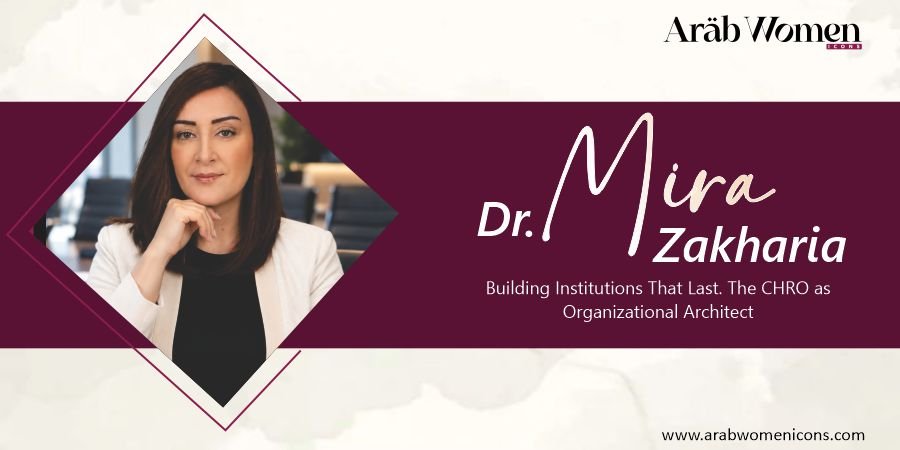
Building Institutions That Last. The CHRO as Organizational Architect
Organizations rarely struggle because of a single problem. A structure may look sound while accountability remains unclear. A policy may be well designed yet fail in practice. Growth may create new opportunities while quietly placing pressure on people, culture, leadership and governance. Understanding these connections requires looking beyond individual HR functions and seeing how an institution actually works, grows, adapts and sustains itself.
This is the space in which Dr. Mira Zakharia, Corporate Vice President Talent & Culture at Rotana Hotels, has built her work. Her focus is driving institutions to grow, transform and perform without losing the people, culture and governance that make performance sustainable. Her career spans oil and gas, healthcare, public health, education, government, tourism and hospitality, giving her a cross-sector view of how complex organizations build capability, alignment and transform.
Seeing the Organization Beyond HR
Working across very different sectors early in her career taught Dr. Mira Zakharia that most organizational problems eventually reveal themselves through people but rarely originate there alone. A performance issue may be an accountability issue. High turnover may point to a leadership problem. Low engagement may reflect poor organizational design, while a succession gap may expose a much larger business continuity risk.
Dr. Mira Zakharia was also fortunate to work with, observe and learn from exceptional leaders throughout her career: people who understood business deeply, made difficult decisions with clarity, read organizations beyond what appeared on the surface and demonstrated that leadership is as much about judgment and character as technical expertise. Those experiences shaped how she thinks and reinforced the importance of never stopping learning.
For Dr. Mira Zakharia, a people issue cannot be understood in isolation. It requires understanding the business, its strategy, economics, operating model, ambitions and external environment, while also understanding the people behind it: their capabilities, needs, aspirations, motivations, personalities and interactions. The same structure or leadership approach can produce very different outcomes depending on organizational maturity and context. “I rarely look for one-dimensional answers. I look at the whole system, the connections within it and the consequences a decision in one area can create elsewhere.”
People Strategy as Institutional Infrastructure
Dr. Mira Zakharia uses the phrase “institutional infrastructure” carefully. She does not believe people strategy sits underneath the organization as though everything else depends on it. Organizations succeed when strategy, structure, people, leadership, governance, finance, technology, operations, culture and risk work as a synchronized system.
People strategy is one critical part of that wider system because it connects directly to execution. It means designing roles, accountability, capability, workforce planning, leadership depth, succession, reward, performance, governance, data and decision rights with the same discipline applied to other parts of the business.
“The objective is not to build a strong HR function in isolation. It is to build a synchronized organization.” An excellent business strategy can remain a plan if the organization lacks the structure, capability or leadership to execute it. Equally, strong people practices create little value if they are disconnected from commercial priorities and operational realities.
Building Talent for Hospitality at Scale
At the heart of hospitality, Dr. Mira Zakharia sees one fundamental reality: the guest experience is inseparable from the colleague experience. Exceptional assets, technology and brand positioning matter, but hospitality is ultimately delivered human to human and from the heart. The people agenda therefore has to reflect how the organization intends to grow, compete and deliver consistently.
Her priorities include leadership capability at scale; sustainable national talent pipelines that create real careers rather than simply meet quotas; belonging, wellbeing and fairness as operating disciplines; and stronger digital and data maturity so leaders can make better workforce and talent decisions. Partnerships such as Rotana’s Emirati scholarship pathway with Les Roches Abu Dhabi are part of building long-term capability by connecting education, industry exposure and career opportunity.
Across a multi-country organization, another challenge is consistency without losing local relevance. Guests should recognize the brand wherever they go, and colleagues should experience the same core standards of fairness, leadership and culture, while each property remains sensitive to its market, legislation and local identity. The priority is not a collection of HR programmes, but organizational capability that allows the business to grow without weakening leadership, diluting culture or compromising the guest promise.
Reading the Signals Before They Become Problems
Dr. Mira Zakharia approaches organizations by looking for what does not reconcile. Numbers matter, but so do observation, patterns and the things people do not say. Turnover may appear normal until it is concentrated under one leader. Overtime may look operationally necessary when it is compensating for poor workforce planning. Multiple approvals may reveal that nobody truly owns the decision.
Experience helps her read those signals: the room, the silences, recurring frustrations and inconsistencies that often surface before a dashboard catches them. She then tests observation against data and evidence, classifies dysfunctions, examines root causes and works close to teams because operational reality can look very different from corporate reporting.
Diagnosis, however, is only the beginning. Sustainable change is collaborative. She works through partnerships with leaders, teams and stakeholders to build solutions people can own and sustain. She also translates organizational issues into business terms, performance, cost, risk and customer impact because this is how people and organizational issues become enterprise decisions. “Most institutional crises are preceded by small signals. The real skill is seeing them, connecting them and acting before they become normalized.”
Accountability Needs Structure and Trust
Dr. Mira Zakharia considers accountability one of the most underrated performance tools. Clarity is respectful: it tells capable people what they own, what is expected of them, where they can act independently and where alignment is required.
In her experience, many performance issues labelled as people problems are actually accountability-design problems. Overlapping roles, unclear decision rights and uncertain ownership can make capable people underperform. In such cases, redesigning the structure and clarifying accountability can be more effective than replacing individuals.
But accountability is not simply telling someone, “You own it.” People need the right capability, information, authority, governance, guidelines and support. Empowerment requires leaders to exercise judgment within shared standards and clearly defined authority. Across a corporate or global organization, autonomy without guardrails can quickly become inconsistency and chaos.
Accountability must be supported by the capability and authority to deliver. “The objective is not maximum autonomy. It is the right level of autonomy, supported by the right capability and governance. It is building governance, capabilities, accountability and trust”
Governance That Creates Guardrails
Good governance is almost invisible when it works, but expensive when it is missing. As organizations grow, informal ways of working stop being enough. Effective people governance combines clear policies and standards, defined authority and decision rights, and assurance through data, audits, review cycles and feedback.
Governance should evolve with organizational maturity, providing closer guidance where capability is developing and broader authority where leaders and systems can support it.
In a multi-country business, governance must also balance consistency with local relevance. Principles of fairness, ethics and accountability should remain consistent, while application respects local legislation, culture and operating realities consistency of principle with accuracy of application.
Governance should never become bureaucracy for its own sake. Poor governance adds approvals and slows decisions; good governance removes ambiguity and gives capable leaders confidence to act. “Governance is not about controlling people. It is about creating the guardrails within which good judgment, accountability and empowerment can operate safely and consistently.”
Leadership Capability as Business Risk
Strategy and growth can move faster than leadership capability. An organization may enter new markets, digitize operations or transform its business model, but if leaders cannot manage complexity, build teams, make decisions or communicate through uncertainty, transformation becomes fragile.
That makes leadership capability a business risk, not simply an L&D topic. Organizations should assess leadership depth with the same seriousness they apply to financial or operational risk: where are the critical roles, who could step into them, which leaders can operate at the next level of complexity, and where is the business overly dependent on individuals? Succession planning is therefore not a replacement chart; it is organizational risk management.
Turning Values into Everyday Behaviour
For Dr. Mira Zakharia, values become culture only when they influence behaviour. The real test is what happens under pressure: when someone makes a mistake, when departments disagree, or when a high performer behaves badly.
Values need to translate into observable behaviours across decisions, communication, recognition, meetings, performance management and succession. Leaders create culture through what they encourage, ignore, reward and challenge. “Culture is not what an organization says about itself. It is what people repeatedly experience through its decisions, behaviours and interactions.”
Growth Without Breaking Capability
Dr. Mira Zakharia believes growth is positive, but growth that outpaces organizational capability or depends on individual heroics can quietly damage what made an organization successful in the first place. Responsible growth asks whether leadership depth, structures, systems, workloads and capability are developing at the same pace as commercial ambition.
Organizations can celebrate expansion while overlooking burnout, capability gaps, loss of institutional knowledge or declining leadership quality. They can also set successful talent up to fail by giving people responsibilities for which they, the structure or the organization are not yet ready. A people-first approach does not mean avoiding difficult business decisions; it means making them with a clear understanding of sustainability, readiness and long-term performance.
Lessons Across Different Institutions
Every environment has taught Dr. Mira Zakharia a different discipline. Government institutions often operate within broader national priorities, public-value mandates and complex stakeholder environments. Private organizations may move with greater commercial urgency. International businesses add complexity through geography, culture, regulation and operating models.
Her cross-sector experience prevents her from assuming that one industry owns the best answer. She can take the governance discipline of one environment, the operating rigor of another and the agility of a third. That ability to transfer ideas across institutional boundaries increasingly shapes both her transformation work and her advisory perspective.
Connecting Education with the Future of Work
Through her advisory work with academic institutions, Dr. Mira Zakharia sees the education-to-workforce gap as being less about knowledge alone and more about readiness. Organizations increasingly need people who can think critically, communicate clearly, work across disciplines, use technology intelligently, solve unfamiliar problems and adapt continuously.
Education and industry cannot operate as separate systems with graduation acting as the handover point. Employability should be designed much earlier through schools, families, communities, universities, internships and meaningful exposure to work. The future belongs less to people trained for one fixed job and more to people equipped to keep learning and evolving.
The CHRO as Organizational Architect
As technology, workforce expectations and organizational models change, Dr. Mira Zakharia sees the CHRO role expanding well beyond traditional HR expertise. The CHRO of the future is part organizational architect, part transformation leader, part risk adviser, part culture steward and part strategic counsellor to the CEO and board.
Technology and AI will automate significant elements of administration and analytics. That should elevate the profession, not threaten it. The value of the CHRO will increasingly lie in judgment: understanding organizational dynamics, anticipating workforce risk, challenging leadership assumptions and connecting people implications to enterprise decisions.
CHROs should be comfortable discussing productivity, operating models, governance, technology, risk, growth and organizational performance. “The seat at the executive table should not exist simply because people are important. It should exist because organizational capability is fundamental to enterprise value.”
What Remains After Leadership
Looking across the institutions and people she has influenced, Dr. Mira Zakharia wants to leave behind organizations that are stronger because their systems, leadership and cultures became stronger, organizations with clearer accountability, deeper succession and less dependency on particular individuals.
She also wants people who have worked with her to become courageous leaders themselves: willing to speak honestly, make difficult decisions with integrity and understand that performance and humanity are not opposing choices.
For Dr. Mira Zakharia, leadership is not measured only by what performs while a leader is present. It is measured by what remains capable after that leader leaves. “If the institution is stronger, the leaders are better and people have more opportunity because I was there, that is a legacy worth having.”