Artificial intelligence is changing the way organizations think about work, decision-making, innovation, and the services they provide. Yet the most important conversations around AI are no longer limited to what technology can accomplish. They are increasingly about how that technology can be used thoughtfully, how people can adapt to it, and whether the changes it brings genuinely improve the way organizations and communities function. In this evolving space, the distance between technological possibility and meaningful human impact is where much of the real work begins.
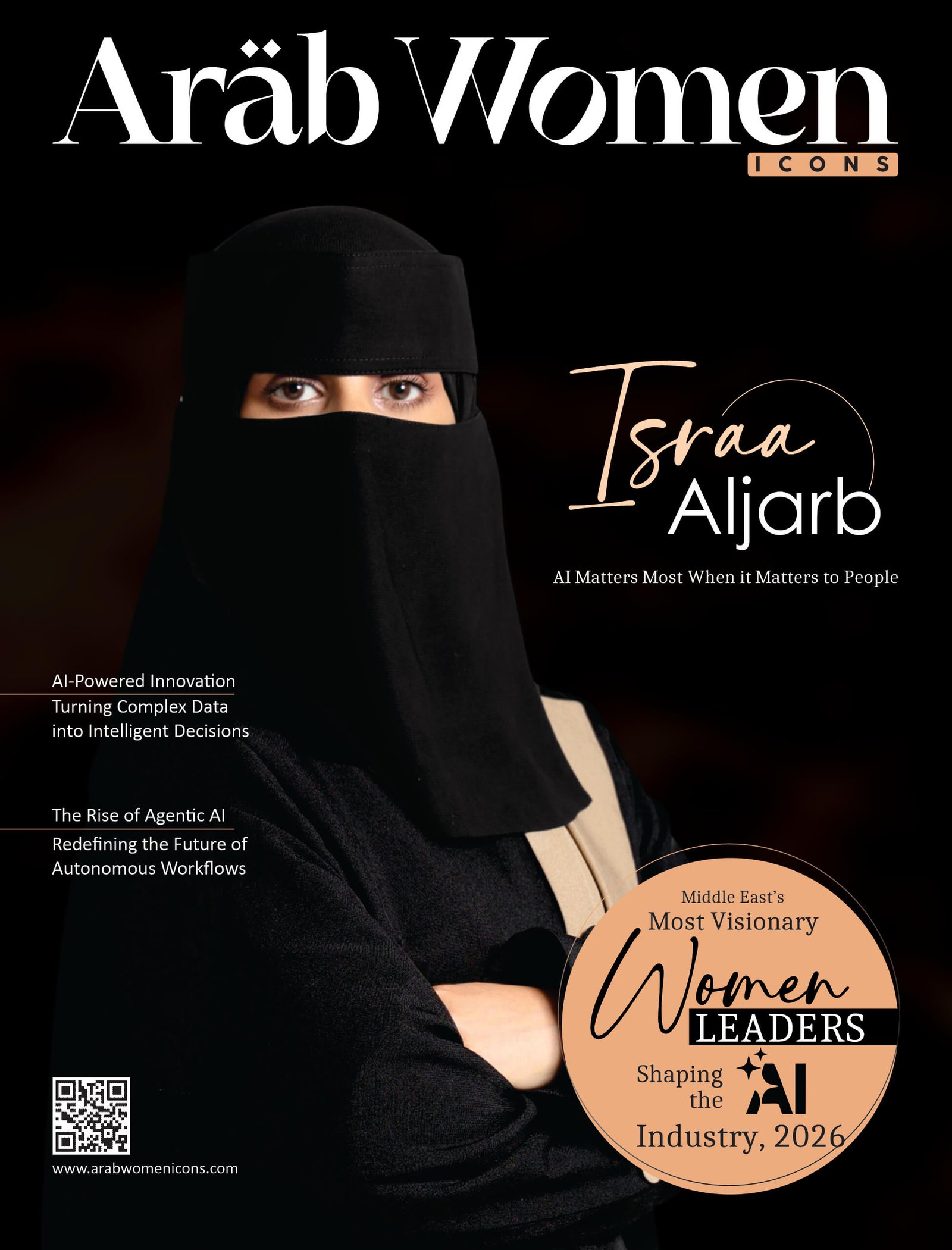
This is the space in which Israa Aljarb, AI and Digital Transformation Professional, has built her work. Her journey across AI, consulting, research, and leadership has given her a perspective that looks beyond algorithms and systems. She is interested in the questions that come after the technology is introduced: What problem is it solving? Who does it serve? How does it change the way people work? And what needs to be in place to make that change lasting?
Her experience has shaped a simple belief that runs through her approach to transformation: technology creates possibilities, but its real value is found in what it enables people and organizations to achieve. Whether the challenge involves AI adoption, organizational change, research, or responsible innovation, she looks for the connection between technical capability and a real human or business need.
The Journey into AI Began with a Question
Every meaningful career begins with a starting point, and Israa Aljarb’s began with questions. sraa Aljarb did not grow up surrounded by technology. She grew up curious about how things worked, why they were built a certain way, and whether there was a better way to solve a problem.
Science, mathematics, and engineering came naturally to her. When she learned her first programming language in high school, something clicked. She discovered that numbers and logic could become real systems, solutions, and ideas capable of helping people.
Growing up in a small village where access to technology and education was limited, Israa Aljarb learned early to make the most of what was available. During university, she did not even have her own laptop and often relied on university computers. Rather than limiting her ambition, those circumstances made her more determined to learn. She looked beyond the curriculum, explored new areas of technology, and actively sought projects and leadership opportunities.
Her first meaningful encounter with AI came through a professor who introduced her to pattern recognition. She was fascinated by the possibility that patterns hidden within data could become solutions to real-world problems. That was when she began seeing AI as more than technology. It became a way to turn knowledge into impact.
After completing her bachelor’s degree, her desire to learn took her to UC San Diego on a full scholarship for graduate studies in robotics and AI, where she had the opportunity to learn alongside leading minds in the field.
Looking back, one thread connects the journey: she has always wanted to understand, improve, and solve. AI became the language through which she could do all three.
When AI Became About People
What first drew Israa Aljarbto AI was the realization that behind every pattern, dataset, and algorithm is a human problem waiting to be understood and potentially solved. Her early exposure came through pattern recognition, but her perspective changed when she began exploring how AI could contribute to the early identification of developmental conditions in children. She saw how a technical solution could potentially help a child and family receive support earlier.
That experience changed what AI meant to her. Its value was no longer simply about what the technology could accomplish, but about what it could make possible for people.
Since then, one question has remained central to her work: how can AI’s capabilities be connected to real human and societal needs?
From Technical Capability to Meaningful Impact
Each stage of Israa Aljarb’s career has given her a different lens through which to understand technology, organizations, and people. Her academic journey built the foundation. Studying computer science and later specializing in intelligent systems, robotics, and AI gave her the technical depth to understand how these technologies work, approach complex problems, and think analytically.
Consulting brought a different perspective. She learned that a technically strong solution is only the beginning. The greater challenge is understanding the problem behind the problem, connecting technology to an organization’s actual needs, communicating its value to different stakeholders, and turning an idea into something that can be implemented and measured.
Her thinking gradually shifted from asking, “Can we build this?” to asking, “Why does it matter, who does it serve, and how will it create value?”
Leadership expanded that view further. Today, she considers the wider impact of every decision. When looking at a project or initiative, she thinks beyond what it can deliver for one team or organization. She considers how many people it could help, how it might change the way an institution operates, and whether it could influence an ecosystem or sector.
That perspective has also shaped how she sees the role of people in an AI-driven world. She believes technology should elevate what people can do rather than simply replace them. It can help professionals make better decisions, remove unnecessary burdens, improve access to services, create new opportunities, and ultimately improve people’s lives.
Learning to Ask, “Right for Whom?”
A major turning point in Israa Aljarb’s career came from working in a professional and cultural environment very different from her own. She worked alongside people from different countries, generations, disciplines, and backgrounds, and the experience changed how she approached both problems and leadership. She learned that there is rarely one way to understand a problem and that a solution that works for one person may not work for another.
The question therefore became more nuanced. It was no longer simply, “What is the right solution?” It became, “Right for whom?” That shift changed the way she leads. She learned the importance of listening, adapting, finding common ground, and creating solutions that account for different perspectives.
Today, when faced with a complex problem, she deliberately steps outside her own assumptions and asks who is affected, what their reality looks like, and what she might be missing. The experience taught her that solving problems is not simply about finding the right answer. It is about finding an answer that works meaningfully for the people it is intended to serve.
Starting with the Problem, Not the Technology
Israa Aljarb’s approach to transformation begins with a question that can easily be overlooked: what problem are we actually trying to solve?
She does not begin with technology. She begins with people, the organization, and the outcome they want to create. Who is experiencing the problem? What do they actually need? What is preventing the organization from achieving its goals? And where can technology genuinely make a difference?
Once the need is clear, she looks at where AI, data, or digital technologies can create the greatest value, rather than simply where they can be applied. Her consulting experience reinforced the importance of taking an idea beyond the concept stage. A technically sophisticated solution has limited value if people cannot adopt it, if it does not fit the organization’s priorities, or if its impact cannot be measured.
She therefore views transformation as a complete journey: defining the problem, designing the solution, aligning stakeholders, implementing it, measuring results, and continuously improving it.
The people affected by transformation also have to be part of that journey from the beginning. Their experiences, concerns, incentives, and ability to adapt cannot be treated as an afterthought.
Israa Aljarb measures transformation by what changes after the technology is introduced. Did it solve a meaningful problem? Did it create measurable value? Did it improve people’s experience? Did it build capabilities that can continue generating value?
Technology may be the enabler, but human and business outcomes determine whether the transformation has truly made a difference.
The Mindset Behind Meaningful Transformation
Israa Aljarb does not believe the organizations that successfully embrace AI are necessarily those with the most advanced technology, the largest datasets, or the most sophisticated solutions. The real difference, in her view, begins with mindset.
Organizations that make AI meaningful are willing to rethink how they work, make decisions, and create value. Their people are open to learning, adapting, questioning established practices, and developing new skills. They also understand that AI is not simply another technology being introduced into an organization. It can change how the organization itself operates. That requires a cultural shift. People need to feel that transformation is something they are part of, rather than something being done to them. Leaders have to create room for experimentation, encourage learning, and give people the confidence to adapt.
This becomes especially important with AI. The question should not only be, “How can we automate this?” It should also be, “How can we use AI to help our people do more meaningful, higher-value work?”
An AI-ready organization, she believes, is ultimately built around people who are willing to think differently, keep learning, and embrace change.
Innovation is Stronger When Responsibility Comes with It
Israa Aljarb does not see innovation and responsibility as competing priorities. She sees responsibility as part of what makes innovation sustainable and meaningful. Working across AI, research, and advisory has taught her to look at new ideas from more than one perspective. She asks what is possible, what problem can be solved, and how much value can be created. At the same time, she considers what could go wrong, who could be affected, what assumptions are being made, and what responsible implementation should look like.
As AI becomes increasingly present in everyday life, these questions carry greater weight. Decisions involving AI can influence privacy, safety, access to opportunities, and people’s trust in the systems around them.
Her approach is to bring different perspectives into the conversation early. Teams are encouraged to challenge assumptions, consider who may be affected, examine risks alongside potential benefits, and think about governance and accountability from the outset.
Her advisory experience has also shown her that responsibility needs to be practical. Organizations need more than principles. They need ways to turn those principles into decisions, processes, and actions.
Resilience is Knowing What to Do Next
Some of Israa Aljarb’s most challenging professional experiences have taught her that resilience is not simply about pushing through difficulty. It is about having the clarity to make difficult decisions, take responsibility for them, and continue moving forward.
Those experiences taught her to focus on what she can control, remain grounded in her values, and make choices based on the long-term goal rather than what may feel easiest at the moment. They also changed the way she leads. She became more comfortable with uncertainty and learned that leadership often requires making decisions before every answer is available, then adapting as new information emerges.
Setbacks, she learned, do not necessarily have to change the direction of a journey. They can strengthen the way that journey is led.
Legacy is What Continues After You Step Away
Israa Aljarb sees legacy as something larger than personal achievement. To her, it is what continues because she was part of building it. She wants to leave behind stronger capabilities, better systems, meaningful knowledge, and opportunities that allow others to take the work further than she could herself.
That makes legacy less about being remembered for individual accomplishments and more about creating something that continues to generate value after she is no longer the person leading it.
Giving the Next Generation a Starting Point
Building capabilities and creating opportunities for the next generation is central to the kind of transformation Israa Aljarb wants to lead. Her own journey showed her how much a single opportunity can change someone’s direction. Coming from an environment where access to technology, resources, and exposure was limited, she understands the difference that knowledge, mentorship, and an open door can make. That experience shaped her belief that transformation should build people as much as it builds technology.
The next generation needs the capabilities, confidence, and opportunities to become creators of what comes next, rather than simply users of what exists today. She wants the people who work with her or learn from what she builds to take those foundations further than she could on her own.
The Question Is No Longer What AI Can Do
Israa Aljarb believes AI and digital transformation will reshape far more than organizational processes and industry models. They will influence how people work, learn, communicate, access services, and make decisions.
The world, she notes, is no longer preparing for an AI future. It is already living in one. As AI becomes more deeply embedded in everyday life, the challenge will not simply be making it more capable, but ensuring that its growing capabilities are governed responsibly.
Organizations will need to reconsider their processes and business models while also thinking seriously about trust, data protection, bias, and meaningful human oversight.
Powerful technology without trust cannot create sustainable transformation. She sees the future of AI in systems that are intelligent while also being fair, safe, accountable, and human-centred. The question is gradually shifting from “What can AI do?” to “How do we ensure what AI can do is worthy of people’s trust?”
Preparing Organizations Before Change Demands It
Israa Aljarb believes leaders need to stop treating AI as a technology project and start viewing it as organizational transformation. That means investing in people and capabilities, becoming comfortable with continuous change, strengthening data and governance, and creating a culture where experimentation and learning are part of everyday work.
More importantly, leaders need to ask a different question. Instead of focusing only on what technology the organization should adopt, they should consider what kind of organization and workforce they need to become.
The organizations prepared for the next decade will be those that begin developing their people, culture, data, leadership, and decision-making capabilities today, rather than waiting until change becomes unavoidable.
The Future is Stronger When More People Can Shape It
Looking at everything she has built so far, Israa Aljarb wants to help create a future where technology is valued not simply because it is possible, but because it improves lives, strengthens organizations, and creates opportunities for people. She believes meaningful transformation happens when technology is connected with purpose, when AI helps people do more, enables organizations to become better, and is developed with the responsibility and trust its impact requires.
Yet she does not want her contribution to end with what she builds. She wants to develop people, capabilities, and opportunities alongside technology, opening doors for those who come after her and leaving behind a stronger foundation than the one she started with.
If there is one thing she hopes people remember, it is not simply the projects she delivered or the positions she held. It is that she turned curiosity into impact, technology into possibility, and opportunity into a path for others. Her definition of success extends beyond personal progress. It is also measured by how much farther others can go because she was there.