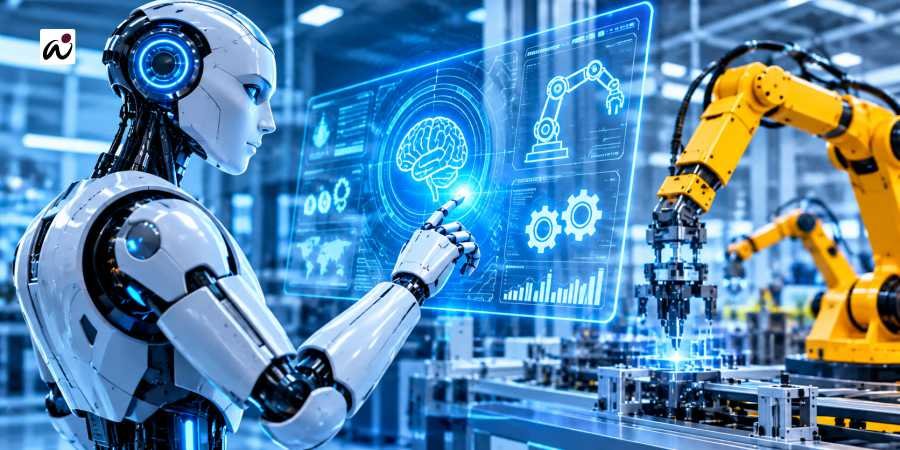
How the Robotics Industry Is Transforming Manufacturing, Business Operations, Human Productivity, and Everyday Life
There are changes being experienced in terms of the manner through which business is conducted, competition in various industries and interaction with the surrounding environment. One of the changes that have greatly contributed to these changes is the ability of machines to do tasks that require precision and adaptability.
The area of robotics is no longer constrained to simple tasks within controlled environments like in manufacturing. Instead, robotics is now spreading into other industries such as health care, logistics, agriculture, construction, retail and delivery of essential services.
Robotics industry is heading towards a period where machines will not be required to simply follow programs. With advancements in areas of artificial intelligence, machine vision, sensor technology, computing and mechanical engineering, machines are now able to analyze the surrounding environment and adjust to different situations. These changes provide an opportunity for organizations wishing to enhance efficiency in their operations.
Redefining Industrial Productivity
Automation of manufacturing continues to be one of the most common areas for robots. Manufacturing companies use robotic systems to help them in such operations as assembly, material handling, welding, testing, packing, among others. Through these uses, companies are able to ensure that their work processes are precise, accurate, and consistent.
The modern factory is slowly becoming a networked facility through which machines interact with the production processes, detect any anomalies, and assist in making sound decisions. One way this has been achieved through robotics is the ability of firms to adapt to changes in demand, improve efficiency and eliminate disruptions in repetitive manual operations.
For the manufacturers, automation has benefits beyond faster work processes. The increased precision ensures less material waste, whereas the consistent process execution improves product quality.
The Growing Role of Intelligent Robotics
Robotics technology has advanced due to the integration of artificial intelligence. The use of machine learning, sophisticated sensors, computer vision, and data processing in real-time enables robots to detect objects, move around an environment, identify patterns, and react appropriately to unforeseen situations.
The application of this innovation has transformed the robotics sector from one that mainly focused on mechanical automation to one where robotics includes intelligent software, engineering, and decision-making. Robots are now being created to be used in environments that are unstructured in comparison to traditional manufacturing environments such as warehouses, hospitals, public areas, and outdoors.
Intelligent robotics can also enable more flexible business processes. Instead of having to undergo extensive reprogramming whenever there are changes in operations, some robots can learn using data, adapt their motions, and interact with other devices. This has proven beneficial in industries where products or services change frequently.
Transforming Healthcare and Human Services
Robots are gaining relevance in the healthcare industry. Robots are employed in surgery to perform surgeries with high precision, and rehabilitation robots assist patients in regaining mobility and enhancing their motor skills. Other automated systems are employed in laboratories, administering drugs, disinfecting, and moving materials in healthcare settings.
The role of robotics in the development of the healthcare industry is expected to be the improvement of precision and assistance to clinical teams and management of increasing challenges in healthcare organizations. Robots could be helpful for those operations that require repetition and/or difficult working conditions in healthcare facilities.
Nevertheless, healthcare robotics should be carefully evaluated. Patient safety, clinical validation, cybersecurity, affordability, training, and accountability should stay at the forefront of roboticization in healthcare facilities. Technology should assist but not substitute the professional knowledge and judgement in healthcare.
Robotics Across Logistics, Agriculture, and Construction
Beyond manufacturing and medicine, robotics has begun to change how other sectors operate, which are characterised by labour shortages, complex operations and harsh environments. Robotics are being used in warehouses to transport inventory and perform picking operations, thereby improving the handling of goods. This technology can be used together with people in the organisation to handle large quantities of orders and deliver them within the stipulated time.
Robotics is being considered in agriculture to assist in activities such as accurate planting and harvesting, crop monitoring, weed elimination and optimisation of resource use. Cameras, sensors and mapping systems can be combined with automation equipment to facilitate better decision making and less wastage of resources in agricultural settings.
The construction sector can also take advantage of robotics that can help with surveying, material transport, repetitive assembly, inspections and building operations.
Human-Robot Collaboration and the Future of Work
One of the key advancements made within the field of robotics has been the creation of collaborative robots, also referred to as cobots. These differ from traditional industrial robots in the sense that they are intended to operate in particular settings and work hand-in-hand with humans in an environment that has been assessed for safety measures.
The use of collaborative robots brings about a shift in the automation process because employees will have to engage in tasks requiring critical thinking, problem solving skills, communication and supervision among other skills while robots are responsible for performing monotonous, strenuous and precise jobs.
The growth of the robotics sector will also affect employment needs as companies will require automation technicians, robotics engineers, maintenance staff and systems integrators among others.
Investment, Innovation, and Commercial Opportunities
Robotics is generating opportunities in hardware, software, engineering, component manufacture, artificial intelligence and industrial services. There is demand for sensors, actuators, controls, robotic arms, autonomous navigation systems and specialized software, which is driving innovation along the whole value chain of technology.
In order to use robotics effectively, organizations have to do more than simply buy machinery. The organization has to consider what their needs are, how much it will cost them to integrate the machinery, how easy it will be to maintain, the level of preparedness of their employees and security issues. The best use of robotics would be to implement technologies that can help solve existing problems.
Smaller firms could use task-specific robot modules as technologies become more affordable.
Navigating the Challenges of Automation
Even with all these positive features, robotics is not without drawbacks which companies need to keep in mind. The high cost of implementation, the intricacies involved in integration and maintenance, lack of necessary skills, worries about job loss, as well as the problem of securing robots against cyber attacks and any disruption in their performance through unauthorised access are some of the major challenges facing organisations implementing robotics in their operations.
In particular, one should note the problem of reliability of automated machines in unpredictable conditions, as a machine that works very well in controlled conditions may run into problems in the presence of uncontrolled variables such as unpredictable shapes of objects, changes in the environment, or human actions.
Building a More Intelligent Industrial Future
Future developments in robotics are not just going to involve machines getting bigger or faster, but rather becoming more useful, versatile, and incorporated into our surroundings. Together with engineering advancements and artificial intelligence, robots will increasingly perform tasks that are reliant on perception, coordination, precision, and constant action.
The field of robotics holds a promising place within the realm of future industrial growth, business activities, and public services. In the long run, it will all be determined by how good innovation works at adding value, how responsibly the companies implement automation, and how well the societies prepare their labor force for the technological transformation.
Robotics is about making humans and companies do more. If used appropriately and in the right way, smart robots can be a great partner in creating safe working places, successful industries, and efficient global economy.