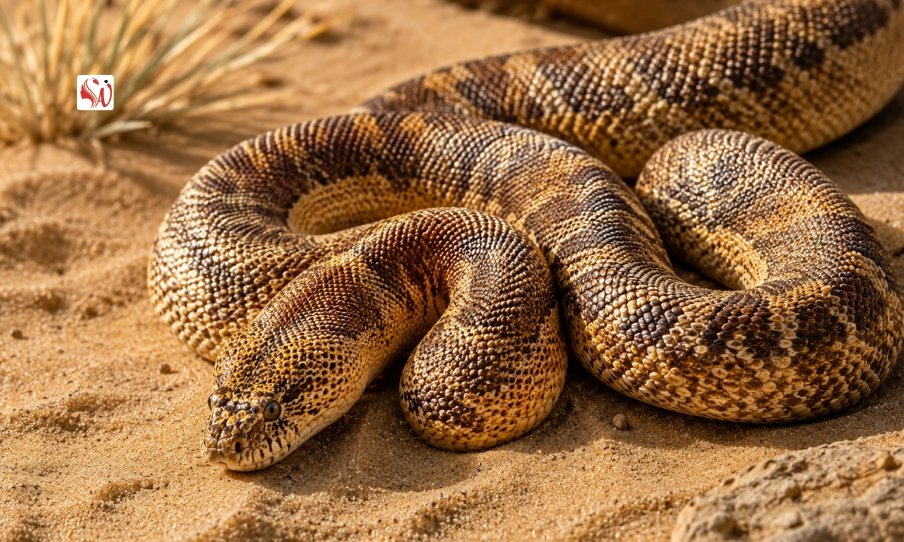
Deep in the Middle East, among the rolling dunes, there lives a strange and wonderful beast known as the arabian sand boa. Unlike many of its more fearsome constrictor friends, this little snake has several adaptations that allow it to thrive in an environment much harsher than most. For the curious and inquisitive reptile enthusiast, the arabian sand boa serves as the poster child of a world made of sand. Discovering what makes up this fascinating creature will allow one to see just how a snake can take a desert, and make it its home.
Secrets of the Sand
In order to learn about the day to day life of the arabian sand boa, one must first examine the many unique adaptations found on the body of the snake, specializations that allow it to slide effortlessly beneath the searing heat of the desert sun. The most distinctive feature of the arabian sand boa is the set of small, bead-like eyes located on the top of its head. This unique adaptation allows the snake to burrow completely underground, leaving only its eyes exposed, giving it the ability to both hunt and be hunted, though it is much more common to see one lying in wait. Due to the nature of the snake’s habitat, its scales are extremely smooth, allowing it to slide through the sand with relative ease. As most animals that follow this type of subterranean lifestyle, the arabian sand boa uses the underground tunnels to escape the oppressive daytime heat, taking shelter beneath the ever-shifting dunes.
Hunting Strategies Beneath the Dunes
When darkness falls over the desert landscape, the arabian sand boa transforms into an incredibly patient and highly effective ambush predator. Because visibility is low and moving openly across the desert surface invites danger, the arabian sand boa relies entirely on stealth and tactile precision to secure its next meal. It lies perfectly still beneath a thin layer of sediment, waiting for small geckos, lizards, or desert rodents to wander directly over its hidden position. The moment an animal steps within range, the arabian sand boa strikes with astonishing speed from beneath its sandy blanket, constricting its prey before the target even realizes it is under attack. Because water is incredibly scarce in this arid environment, this specialized hunter extracts nearly all of its necessary hydration directly from the bodies of the prey animals it consumes, showcasing a brilliant survival mechanism.
Gentle Nature and Captive Care
In recent years, the unique appearance and manageable size of this species have made the arabian sand boa an increasingly popular choice among reptile hobbyists worldwide. Unlike many other sand-dwelling species that can exhibit defensive or high-strung behaviors, the arabian sand boa is widely celebrated for its remarkably docile temperament and gentle disposition. Captive specimens require a specialized enclosure that mimics their native environment, prioritizing a deep layer of fine, dry sand that allows the arabian sand boa to engage in its natural burrowing behaviors without restriction. Providing a proper thermal gradient is also essential, ensuring they have a hot side to aid their digestion and a cooler side to retreat to when they need to regulate their internal body temperature. Their small adult size, which rarely exceeds fifteen inches in length, makes them an incredibly low-maintenance and rewarding pet for dedicated keepers.
Threats and Conservation Status
While these snakes are masters at avoiding detection, the wild populations of the arabian sand boa face gradual challenges brought about by human expansion and environmental shifts. Urban development, off-road vehicle recreation, and habitat fragmentation threaten the pristine dune ecosystems that the arabian sand boa relies upon for survival. Fortunately, because they spend so much of their lives hidden safely underground, they are somewhat insulated from immediate surface threats, and their current populations remain relatively stable across their native range. Preserving these delicate desert environments ensures that future generations will still be able to marvel at the incredible, specialized existence of the arabian sand boa, a true marvel of natural engineering.