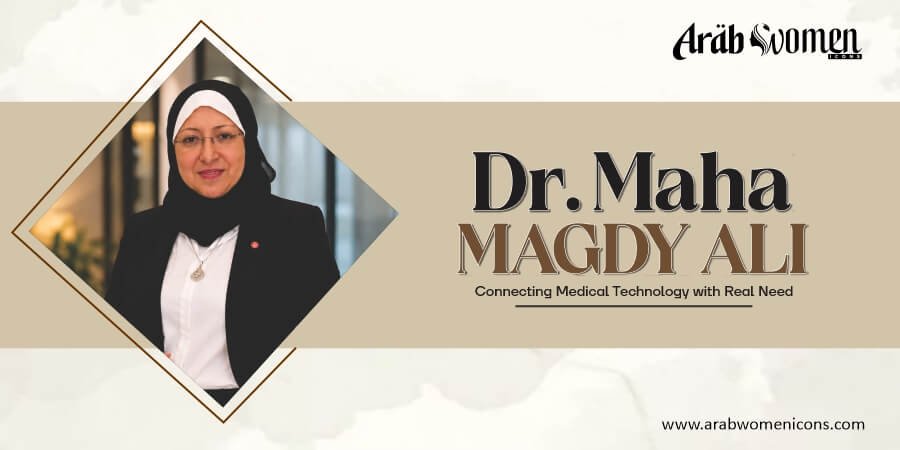
Healthcare is an industry where commercial decisions can directly affect people’s lives. Behind every medical device, rehabilitation technology, assistive solution, or patient-care service is a very practical question: does it genuinely solve a need? Dr. Maha Magdy Ali, a Healthcare and MedTech Executive, has built her career around answering that question with a combination of scientific understanding, commercial experience, and a clear sense of purpose.
With more than two decades of experience across healthcare and medical technology, Dr. Maha Magdy Ali has worked across medical devices, rehabilitation and assistive technologies, hospital and patient-care solutions, and healthcare retail. Her experience spans commercial leadership, strategic partnerships, business development, market expansion, P&L responsibility, and broader general management.
Her professional journey began with a scientific foundation. After studying Biochemistry at Alexandria University, she started her career as a researcher at the Medical Research Institute. Moving into the commercial side of healthcare later in her career opened a different perspective. She realized that her interest went beyond selling a product. She wanted to understand the need behind it and identify the solution that could make a real difference.
That approach has stayed with her as her responsibilities grew.
She moved from direct customer engagement and product selection into specialized rehabilitation and assistive technologies, international partnerships, business development, and leadership roles. Along the way, she also helped build new healthcare capabilities and concepts from the ground up and introduced specialized technologies to meet emerging market needs.
Seeing Healthcare as an Interconnected Ecosystem
Working across medical devices, rehabilitation, assistive technology, hospital solutions, patient care, and healthcare retail has given Dr. Maha Magdy Ali a broad view of what healthcare transformation really requires.
Her experience has shown her that transformation is rarely achieved simply by introducing a new product or technology. The real work begins with understanding the problem and connecting the right solution to the patient, the healthcare professional, the process, and the environment.
Rehabilitation and assistive technology made this particularly clear. A technically advanced solution can still fall short if it does not respond accurately to an individual’s clinical or functional needs. Healthcare retail added another important lesson. Accessibility, service quality, customer experience, and operational systems can be just as important as the product itself.
These experiences have shaped her belief that healthcare transformation needs to be viewed as an ecosystem. Technology, clinical value, commercial viability, operational readiness, and user adoption must work together. Innovation may create the opportunity, but transformation only becomes real when that opportunity turns into something meaningful, accessible, and sustainable in everyday practice.
Leadership Built Through Uncharted Territory
Some of Dr. Maha Magdy Ali’s most formative leadership experiences came when there was no established roadmap to follow. Building new business capabilities, developing healthcare retail concepts from the ground up, establishing specialized rehabilitation solutions, and guiding teams through organizational change taught her an important lesson: leadership is not about having every answer before the journey begins.
It is about creating clarity, developing the right capabilities, and giving people the confidence to move forward.
She has also learned that people can often contribute far beyond what their current roles suggest. Recognizing that potential, placing individuals where they can make their strongest contribution, and giving them both accountability and room to grow have become important parts of her leadership approach.
Her style combines strategic direction with hands-on execution. Expectations need to be clear, and accountability needs to be taken seriously, but people should also feel comfortable asking questions, learning, collaborating, and taking ownership.
In her experience, sustainable performance develops when employees understand not only what they are expected to achieve, but also why their work matters and how it contributes to the larger purpose of the organization.
Growing the Business by Creating Healthcare Value
Dr. Maha Magdy Ali does not view commercial growth and healthcare value as opposing priorities. She sees them as closely connected. A sustainable healthcare business, in her view, grows when the value created for patients, professionals, and organizations is strong enough to support long-term commercial success.
Her starting point is always the need. What problem is being solved? Who benefits from the solution? Can it improve an outcome, address an existing gap, make care more accessible, or help healthcare providers deliver their services more effectively?
The commercial evaluation follows from there. She considers market potential, clinical relevance, competitive differentiation, affordability, operational requirements, and the organization’s ability to support the solution after it enters the market.
This becomes particularly important in MedTech, where successful commercialization often involves much more than a transaction. Demonstrations, professional evaluation, training, user feedback, and ongoing support can all determine whether a solution gains meaningful adoption.
The strongest growth, she believes, comes when value is created across the entire ecosystem. Patients receive an appropriate solution, healthcare professionals trust its value, organizations see a sustainable clinical and operational benefit, and the business earns the opportunity to grow. That is the kind of growth she considers meaningful: growth built on relevance, trust, and lasting value rather than growth for its own sake.
Finding Opportunity Where Others See Gaps
Dr. Maha Magdy Ali’s approach to business development begins with observation rather than products. She pays close attention to what customers, healthcare professionals, and institutions are trying to achieve, where current solutions fall short, and how changes in technology or market conditions may open new possibilities.
Once a gap becomes visible, she evaluates the opportunity from multiple perspectives, including the unmet need, market size and readiness, competitive landscape, clinical relevance, differentiation, pricing, and the capabilities needed to support the solution.
The search then extends beyond the local market. International technologies and potential partners can offer solutions to emerging needs, but their value depends on how well they can be adapted and positioned for the market in which they will operate.
Validation is another important part of her approach. Demonstrations, KOL engagement, professional feedback, and direct market interaction can reveal insights that a spreadsheet cannot provide. Some of the most promising opportunities in her career began as possibilities that were not yet obvious to everyone.
Turning those possibilities into sustainable businesses required more than recognizing the opportunity. It required building the commercial, technical, and operational capabilities to make it work in practice.
Partnerships That Go Beyond Distribution
With extensive experience working with international manufacturers and strategic partners, Dr. Maha Magdy Ali views successful healthcare partnerships as relationships built around shared objectives rather than simple distribution arrangements.
The foundation, in her view, is strategic alignment. Both sides need a clear understanding of the market, realistic objectives, and an appreciation of the value each partner brings to the relationship.
Trust develops through consistency. Manufacturers need transparent market feedback, realistic forecasts, responsible representation of their technologies, and confidence that their local partner is committed to developing the market rather than simply waiting for orders. Local partners, meanwhile, need commitment, responsiveness, training, technical support, and a genuine willingness to work through challenges together.
The strength of a partnership often becomes most visible when circumstances become difficult. Market disruption, organizational changes, delayed opportunities, and competitive pressure can test even strong relationships. Those moments reveal the importance of communication and credibility.
The partnerships that endure are those that gradually move beyond a traditional supplier-distributor relationship. When both sides exchange knowledge, adapt together, and remain focused on long-term value rather than short-term transactions, the partnership becomes part of the wider healthcare ecosystem.
Where Technology Meets More Personalized Care
Dr. Maha Magdy Ali sees the next phase of healthcare transformation emerging from technologies that make care more personalized, predictive, connected, and accessible. Within rehabilitation and assistive technology, she sees considerable potential in AI-enabled systems, robotics, advanced gait and movement analysis, smart mobility solutions, and technologies that generate objective data on patient performance.
Her interest in AI is rooted less in the technology itself and more in its potential to contribute to clinical decision-making and rehabilitation. Solutions that capture performance data, support individualized programs, and allow professionals to monitor progress more objectively can add a valuable layer of insight to patient care.
Dr. Maha Magdy Ali also expects greater convergence between devices, data, remote monitoring, and digital platforms. Such integration could extend care beyond conventional clinical settings and create more continuous connections between patients and healthcare providers.
Yet technology alone cannot transform healthcare. A breakthrough becomes meaningful only when it is clinically relevant, intuitive for professionals and patients, supported by evidence, and economically sustainable enough to move beyond an impressive demonstration into everyday practice.
That also requires healthcare professionals to be involved early. Giving them opportunities to see, test, question, and evaluate new technologies, alongside appropriate training, technical support, and organizational preparation, can make the difference between innovation being introduced and innovation being adopted.
Understanding Different Healthcare Markets
Having worked across government, institutional, and private healthcare markets, Dr. Maha Magdy Ali understands that the value of a healthcare solution may remain consistent while the route to adoption can vary considerably. Her commercial approach begins with understanding how each stakeholder defines value and how decisions are actually made.
Government and large institutional markets generally demand a structured and long-term approach. Specifications, regulatory requirements, tenders, budgets, clinical evaluation, multiple decision makers, and implementation capabilities can all influence the process. Success therefore requires careful preparation, stakeholder mapping, technical accuracy, patience, and an understanding of complex procurement cycles.
Private healthcare organizations may be able to move more quickly, but their priorities can be different. Clinical differentiation, patient demand, service enhancement, operational efficiency, return on investment, and implementation speed can carry significant weight.
Dr. Maha Magdy Ali therefore adapts the commercial pathway without changing the fundamental value of the solution. She listens first, understands the decision environment, identifies what matters to each stakeholder, and builds the appropriate clinical, commercial, and operational case around those needs.
Customer Value as the Compass
Among the principles that have guided her career, Dr. Maha Magdy Ali places customer value at the center. Early in her professional journey, she learned to look beyond what a product was designed to do and ask what problem it could genuinely solve for a patient, customer, or healthcare professional.
At the same time, she recognizes that value alone is not enough. An opportunity can have genuine potential, but without the right people, processes, partnerships, and discipline, that potential may never become meaningful impact.
This understanding has shaped the balance in her leadership approach. Customer value provides the direction, while execution turns that direction into results.
As she puts it, “Customer value is my compass; execution is the engine.”
Bringing Academic Thinking into Real-World Leadership
Dr. Maha Magdy Ali’s Doctor of Business Administration came after many years of practical healthcare experience, making the academic journey particularly relevant to her professional development.
Rather than viewing business strategy and organizational theory in isolation, she was able to connect academic concepts with situations she had already encountered in the market, including growth, customer behavior, service quality, team performance, operational challenges, and business transformation.
Dr. Maha Magdy Ali doctoral research examined the influence of service quality on customer satisfaction across different demographic variables within Kuwait’s medical retail business. Working on a subject closely connected to her professional experience reinforced an important lesson: sustainable growth cannot be created through commercial activity alone. The quality of the customer experience, the processes supporting it, and an organization’s ability to understand different expectations all contribute to long-term success.
The DBA also strengthened her approach to decision-making. Experience develops judgment, while research encourages leaders to question assumptions, structure problems, examine evidence, and distinguish symptoms from underlying causes.
Dr. Maha Magdy Ali background in healthcare quality further developed a mindset of continuous improvement. Instead of focusing only on what went wrong, she looks at how systems, processes, and people can be supported to perform better.
Today, these perspectives come together naturally in her leadership approach: practical market experience, analytical thinking, a quality-driven mindset, and a supportive approach to people. Strong leadership, she believes, is not simply about identifying gaps. It is about creating the clarity and support needed for people and organizations to close those gaps and continue improving.
Turning Possibility into Meaningful Change
To Dr. Maha Magdy Ali, being a trailblazing healthcare leader is not about being the first person to talk about change. It is about recognizing possibilities early and having the discipline to turn them into something meaningful.
Sometimes that means introducing a new technology or building a business where no established model exists. At other times, it can mean challenging traditional ways of working or recognizing potential in an idea or an individual before others see it.
Healthcare adds another layer of responsibility to that role. Innovation ultimately needs to serve people. Leaders must balance ambition with evidence, commercial growth with patient and professional value, and speed with sustainability. They also have a responsibility to create environments where people can learn, question, contribute, and grow.
Dr. Maha Magdy Ali sees that responsibility as extending beyond the organizations that leaders directly manage. Healthcare leaders help shape wider ecosystems by connecting technology, clinical practice, business, talent, and society.
The measure of leadership, therefore, is not limited to personal achievements. It can also be found in what a leader builds, what they improve, and what becomes possible for others because of their contribution.
The Convergence Shaping Healthcare’s Next Chapter
Looking toward the next phase of healthcare, Dr. Maha Magdy Ali sees convergence becoming one of the defining forces across MedTech, patient care, and healthcare business. AI, connected devices, data analytics, robotics, remote monitoring, and increasingly personalized solutions are likely to work together rather than develop in isolation.
Across the Middle East, Dr. Maha Magdy Ali also expects greater attention to localization, digital transformation, stronger healthcare ecosystems, and partnerships that bring technology and capabilities closer to the markets they serve.
This changing environment will require business leaders to connect multiple dimensions of healthcare rather than viewing them separately. Technology, clinical needs, customer experience, data, and economics will all need to come together to create healthcare value that can scale and remain sustainable.
Building a Legacy Beyond the Position
As she looks toward the next chapter of her career, Dr. Maha Magdy Ali wants her impact to extend beyond individual roles or business results. Her ambition is to continue building and transforming healthcare businesses, developing people, introducing meaningful technologies, and creating partnerships and ecosystems capable of generating value long after any one leader has moved on. Her message to emerging healthcare business leaders is straightforward: build depth, not just visibility. That means learning the market, understanding customers, respecting the science, knowing the numbers, staying curious, and continuing to ask why.
A career, in her view, should not be measured only by titles or positions. Its deeper measure lies in what a person builds, what they learn, the people they help develop, the problems they solve, and the value that remains after they leave.
That, to Dr. Maha Magdy Ali, is a legacy worth building.