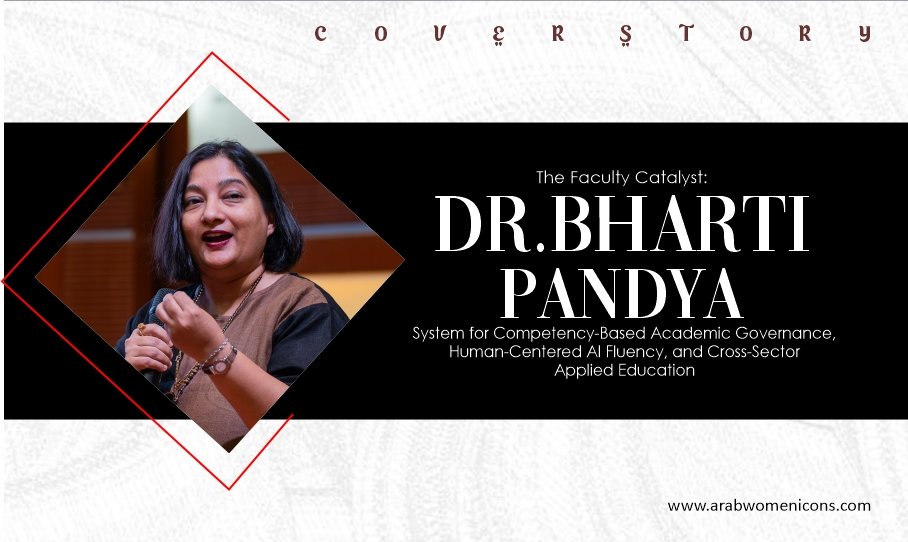
As she knows how to bridge the faculty gap, Dr. Bharti Pandya has transformed academic systems for the automated era. She works for Higher Colleges of Technology (HCT), UAE’s largest federal higher education institution. It is her strategic position. She uses it to reshape the way higher education institutions manage human capital and integrate technology. As the Dean of Faculty Affairs, she channels decades of academic research and advanced corporate strategy directly into the United Arab Emirates educational landscape. Dr. Bharti Pandya views the modern academic ecosystem as a fluid network that requires deep analytical preparation rather than rigid traditional management. Her daily operations demand that she master complex human resource dynamics, evaluate innovative behaviors among academic staff, and analyze virtual learning environments. She does not rely on static educational playbooks. To deliver measurable institutional durability across 2026, she uses her administration of a designed faculty engagement model infused with agility.
A rare academic foundation powers her leadership approach. This foundation is built with a PhD and an EdD. It guarantees that her educational leadership is authoritatively backed up with rigorous field research. To dismantle the traditional silos, Dr. Bharti Pandya applies this dual-doctorate perspective. She found that these conventional limitations often separate administrative governance from active classroom execution. She further ensures her institution remains competitive on a global scale. To do that, she backs her strategic decisions with elite industry credentials. They include her holding senior certifications: The Higher Education Academy’s (SFHEA) Senior Fellow. A Chartered Member of the CIPD (MCIPD). And a Senior Professional in Human Resources (SPHR). She trains her faculty divisions to prioritize continuous professional upskilling. And further removes the resistance that frequently stalls large-scale digital transformation inside major university networks.
Empowering Faculty Excellence: The Holistic Fluidity of Modern Applied Education
As Dean of Faculty Affairs at the Higher Colleges of Technology, Dr. Bharti Pandya’s role centers on empowering faculty excellence. The modern faculty experience is no longer confined to classroom instruction. Today’s faculty members are educators, mentors, innovators, industry collaborators, researchers, and contributors to national development agendas. At Higher Colleges of Technology (HCT), they recognize that applied education requires faculty to remain agile, future-focused, and deeply connected to industry and community needs. In today’s rapidly evolving academic landscape, the line between academia and industry is increasingly blurred. The modern faculty experience is one where classrooms extend into boardrooms, laboratories, innovation hubs, and industry ecosystems. It is a fluid immersion of real-world industry practice into teaching, while simultaneously integrating academic theories, scholarly activities, consulting projects, and applied research into industry and R&D environments.
She defines the modern faculty experience as a holistic and dynamic professional journey where educators continuously move between academic excellence and industry relevance. Faculty are not only teaching concepts but actively shaping industry conversations, contributing to consulting projects, collaborating with R&D centers, and bringing practical insights directly into student learning experiences. Likewise, industry challenges are increasingly informing academic research, curriculum innovation, and applied scholarly activities. Faculty success today depends on adaptability, lifelong learning, AI and digital fluency, emotional intelligence, interdisciplinary collaboration, and the ability to inspire learners in rapidly changing environments. Her role is to create an ecosystem where faculty feel valued, supported, and empowered to excel beyond traditional academic boundaries while becoming active contributors to both educational transformation and industry advancement.
The Architecture of Capability Building: Individual Development Plans and Competency-Based Graduation
Faculty capability building is critical to institutional success, says Dr. Bharti Pandya. Professional development is one of the most strategic pillars of their academic transformation at HCT. They have established a future-focused and holistic faculty development ecosystem that goes far beyond conventional training models. Her approach is designed to continuously empower faculty through personalized growth journeys, leadership development, industry immersion, and globally aligned academic excellence. At the core of this ecosystem is the implementation of Individual Development Plans (IDPs), where every faculty member strategically maps their professional goals, competency enhancement areas, leadership aspirations, scholarly interests, and long-term career pathways. These plans are not treated as administrative exercises, but as dynamic career blueprints aligned with institutional priorities, national workforce agendas, and individual academic ambitions. This enables faculty to take ownership of their professional growth while remaining agile in a rapidly evolving educational landscape.
They have also significantly strengthened career progression pathways by creating transparent and structured opportunities for advancement into academic leadership, applied research, curriculum innovation, industry engagement, and interdisciplinary academic roles. Faculty are actively encouraged and supported to pursue national and international professional development opportunities, specialized certifications, and advanced training aligned with emerging trends, disruptive technologies, and evolving practices within their respective disciplines. One of their landmark institutional initiatives is ensuring that every faculty member completes a professional certification in Competency-Based Education (CBE). This initiative reflects HCT’s deep commitment to transforming learning outcomes and aligning teaching practices with future-ready applied education models. More importantly, it ensures their educators are equipped to develop the competencies, agility, and workforce readiness required for the UAE’s future talent landscape. To celebrate this institutional achievement, they proudly host a Faculty Graduation Ceremony, reinforcing a culture of excellence, recognition, lifelong learning, and professional pride.
To ensure sustained industry relevance, HCT actively sponsors faculty participation in prestigious national and international conferences, global summits, trade exhibitions, specialized forums, and discipline-specific workshops. In addition, they have institutionalized biannual national and international industrial sabbaticals, providing faculty with immersive exposure to cutting-edge technologies, evolving industry ecosystems, innovation practices, and real-world operational environments. These experiences enable faculty to bring authentic industry perspectives directly into classrooms, applied research, and student engagement. Complementing these initiatives, they regularly host distinguished global speakers, executive masterclasses, customized workshops, leadership bootcamps, interdisciplinary innovation forums, and peer-learning engagements that expose faculty to international best practices and transformative educational trends. Through this integrated ecosystem of continuous development, industry immersion, and academic innovation, they are cultivating a highly agile, globally competent, industry-connected, and future-ready academic workforce capable of shaping the next generation of learners and leaders.
Redefining Performance Ecosystems: Catalyzing Growth via Automated Systems and Multi-Pathway Flexibility
Performance management in academia can often feel compliance-driven rather than developmental. Dr. Bharti Pandya shares that at HCT, they are intentionally redefining performance management as a catalyst for faculty success, professional growth, and academic excellence rather than a compliance-driven evaluation process. She strongly believes that faculty members thrive when performance frameworks inspire innovation, self-reflection, accountability, recognition, and continuous development — not when they simply measure outputs against static metrics. Their performance management ecosystem is strategically designed to align institutional excellence with individual faculty aspirations and long-term career success. At its core are SMART objectives, role-based Key Result Areas (KRAs), self-assessment mechanisms, continuous self-progress monitoring, and evidence-based reporting systems that empower faculty to actively shape their professional journeys.
Faculty members are encouraged to co-create meaningful goals aligned with teaching excellence, industry engagement, applied research, scholarly contributions, innovation, mentorship, and service to both internal and external communities. Importantly, this framework is seamlessly integrated with Individual Development Plans (IDPs), enabling faculty to build a comprehensive professional portfolio that supports career progression, leadership readiness, promotion opportunities, academic specialization, and recognition of achievements over time. To further strengthen faculty empowerment and engagement, they have introduced flexibility within the performance framework by providing multiple pathways and achievement options across key result areas such as industry engagement, applied research, scholarly activities, and community service. Faculty members are encouraged to pursue areas that align with their expertise, professional interests, passions, and career aspirations. This personalized approach not only enhances motivation and ownership but also enables faculty to excel in areas where they can create the greatest impact and demonstrate authentic professional strength.
To support transparency, consistency, and empowerment, they have also introduced automated performance rating systems and self-progress tracking tools that allow faculty to continuously monitor their development throughout the academic cycle. This creates a culture of ownership, agility, and proactive growth while significantly reducing the traditional anxiety associated with end-of-year evaluations. Faculty are able to identify strengths, address development areas early, and strategically plan their professional advancement with greater confidence and clarity. Most importantly, their framework recognizes and values the multidimensional nature of academic excellence. Success is not measured solely through classroom delivery, but through broader contributions such as curriculum innovation, interdisciplinary collaboration, industry partnerships, student mentorship, applied research impact, scholarly activities, community engagement, and institutional leadership. By shifting the focus from compliance to capability-building, flexibility, and recognition, they are cultivating a high-performance academic culture where faculty feel empowered to innovate, experiment, collaborate, and continuously elevate their impact. Dr. Bharti Pandya’s ultimate goal is to ensure that every faculty member sees performance management not as an administrative requirement, but as a meaningful enabler of career success, professional fulfillment, and long-term academic growth.
Transparent Trajectories: Fostering Career Progression and Human-Centered AI Integration
Career progression is one of the most critical drivers of faculty engagement, motivation, and long-term institutional commitment. Faculty members need to clearly see that their aspirations can evolve into meaningful leadership, research, and specialized academic opportunities within the institution. At HCT, Dr. Bharti Pandya informs that they have intentionally built a culture where growth is not limited by hierarchy but enabled through transparent systems, equitable opportunities, and structured progression pathways. Generative AI and Agentic AI present both exciting opportunities and important responsibilities for higher education. At HCT, they approach AI not as a replacement for educators, but as a tool that can enhance learning, productivity, creativity, and personalized education when used ethically and thoughtfully.
They are supporting faculty through AI literacy workshops, customized professional development sessions, policy awareness programs, and practical training on responsible AI integration in teaching and assessment. Faculty are encouraged to experiment with AI tools while maintaining academic rigor, critical thinking, originality, and ethical standards. Her emphasis remains on human-centered education. She wants faculty to leverage AI to enhance engagement, efficiency, and innovation while ensuring students continue developing analytical reasoning, problem-solving, creativity, and independent thinking. The key is balance. Technology should empower educators, not diminish the value of authentic learning experiences and meaningful human interaction.
The PULSE Ecosystem: Institutional Well-Being and Navigating Global Diversity
Faculty well-being is foundational to institutional success. Educators who feel supported, connected, heard, and valued are better positioned to inspire students, contribute meaningfully to the institution, and sustain long-term professional excellence, adds Dr. Bharti Pandya. At HCT, they view faculty engagement and well-being not as isolated initiatives, but as an integral part of their institutional culture and leadership philosophy. They have introduced a comprehensive ecosystem of engagement initiatives focused on recognition, communication, collaboration, inclusion, and professional belonging. One of their flagship initiatives is the Annual PULSE Day — HCT’s Academic Day, powered by Unity, Learning, Synergy, and Excellence. This institutional event serves as a platform for peer development, industry-driven workshops, interdisciplinary collaboration, and the showcasing of best practices in teaching, applied research, innovation, and community service. PULSE Day not only celebrates academic excellence but also strengthens a culture of shared learning, institutional pride, and collaborative growth across all campuses.
Diversity is one of the UAE’s greatest strengths, and at HCT, they view multiculturalism as a catalyst for innovation, creativity, and institutional growth. Their faculty community represents more than 96 diverse nationalities, academic disciplines, and professional experiences. To foster inclusion, they focus on building a culture grounded in mutual respect, collaboration, transparency, and shared purpose. They encourage cross-campus collaboration, interdisciplinary teamwork, and open dialogue that values different perspectives and experiences. Their tagline in Faculty Affairs is “Empowering Faculty,” because they firmly believe that student success begins with empowered educators. At HCT, students are at the center of everything they do, and every strategic initiative within Faculty Affairs is ultimately designed to elevate the student experience, strengthen learner outcomes, and prepare graduates for future workforce success. Their entire faculty ecosystem is anchored around what they call the Four Ps — Professional Development, Performance Management, Proficiency, and Promotion. These four pillars are not only designed to support faculty growth and excellence, but are deeply rooted in advancing student success across every dimension of the learner journey, states Dr. Bharti Pandya.
The Four Worlds Convergence: Scaling Industry Alignment via Kaizen and Ikigai
Industry alignment is central to applied education. Faculty must remain connected to evolving technologies, workforce expectations, and sector innovations to ensure learning remains relevant and impactful. She adds that at HCT, they actively encourage industry engagement through industrial sabbaticals, partnerships, consultancy projects, trade events, conferences, professional certifications, and collaborative workshops with industry leaders. They also invite distinguished speakers and industry experts to engage directly with faculty and students, creating valuable opportunities for knowledge exchange and practical insight. These experiences help faculty bring real-world relevance into classrooms while strengthening graduate readiness for future careers.
Dr. Bharti Pandya’s leadership philosophy has been shaped by two Japanese concepts that she deeply resonates with — Kaizen, the philosophy of continuous improvement, and Ikigai, the belief in finding purpose and meaning in what we do. These principles have influenced how she approaches leadership, people development, and institutional transformation. Over the next five years, faculty leadership will be fundamentally redefined by the convergence of technology, human capability, industry integration, and purpose-driven education. She often reflects on PwC’s “Four Worlds of Work” framework — the Red World of innovation and speed, the Blue World of scale and performance, the Green World of purpose and social responsibility, and the Yellow World centered around people, collaboration, and human values. The future of higher education will require institutions to successfully operate across all four worlds simultaneously.
A Global Legacy: Elevating Educational Ecosystems to Empower Future Societies
The legacy Dr. Bharti Pandya hopes to build through her work in Faculty Affairs is one that extends beyond a single institution — a legacy centered on transforming how higher education institutions empower, develop, and elevate their educators to shape the future of society. “If my work can help contribute toward a global higher education culture where faculty are continuously empowered to thrive, lead, innovate, and create meaningful impact, then that would be the most fulfilling and lasting legacy of all,” she concludes.