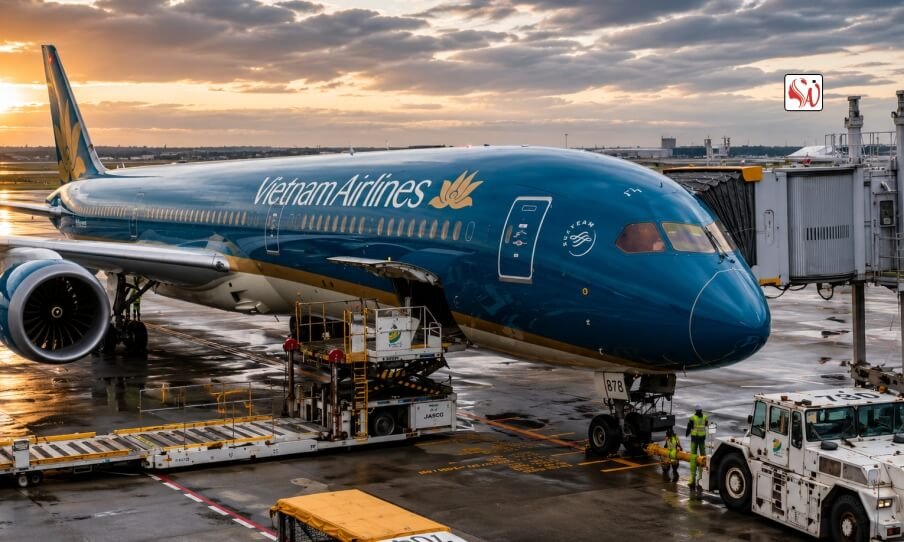
Vietnam’s air transport development is inseparable from the history of its largest airline carrier, Vietnam Airlines. Domestic and international air travel plays an extremely important role in connecting the country with key business and tourism destinations in Asia, Europe, and Australia. Vietnam Airlines’ performance in 2025 serves as an excellent indicator of the company’s ability to scale operations, diversify routes, optimise processes, and reinvigorate the bottom line.
Vietnam Airlines Enters a New Phase of Growth Essay
The 2025 figures for Vietnam Airlines are impressive and represent an increase in the carrier’s operational performance. For example, the number of flights increased from 139,749 in 2024 to 156,235 in 2025 (+11.8%). Moreover, the number of passengers transported grew to 25.64 million in 2025, up from 22.75 million in 2024 (+12.7%). Specifically, the number of international passengers increased by 18.7% (from 7.15 million to 8.49 million), while domestic passengers reached 17 million, up from 15.35 million last year.
The volume of freight transported was also significant, with Vietnam Airlines recording nearly 340,200 tonnes. Thus, Vietnam Airlines’ profit and revenue grew substantially during the year, allowing the carrier to report a significant increase in consolidated revenue and profit. In particular, the carrier recorded consolidated revenue of VND 123.858 billion and consolidated profit after tax of VND 7.607 billion.
Furthermore, the company’s audited financial statements for 2026, released this year, show that Vietnam Airlines recorded VND 121.412 trillion in consolidated revenue. The figure is slightly lower than the VND 123,858 billion recorded in the original 2025 results, which could explain the difference in consolidated revenues in 2026.
A Fleet Designed for Short- and Long-Haul Connectivity
Fleet Strategy
The airline’s growth is primarily driven by its expansive fleet. On December 31, 2025, the company’s aircraft count reached 103. In particular, the fleet comprises 43 Airbus A321ceos, 20 Airbus A321neos, 14 Airbus A350-900, 11 Boeing 787-9s, 6 Boeing 787-10s, 3 Airbus A320neos, and 6 ATR72-500.
The company’s aircraft configuration enables it to serve both domestic and international destinations, providing air travel for regional and long-haul flights. The above composition suggests that narrow-body planes are used for shorter flights, while the Airbus A350 and Boeing 787 families are utilised on longer routes to Vietnam’s major trading partners, including Europe, Australia, Northeast Asia, and other regions.
The airline’s fleet development strategy suggests an even more extensive network growth than projected. The company expects to operate, on average, a large fleet of 102 aircraft in 2026, 110 in 2027, 124 in 2028, 139 in 2029, and 151 in 2030. The company forecasts demand for 43 wide-body passenger aircraft and 105 narrow-body passenger aircraft in 2030, subject to market conditions.
International Demand Is Becoming a Major Growth Engine
One of the most significant changes that we can see in the 2025 statistics is the increase in international demand. For example, the number of domestic passengers grew by only 10.8%, while international passengers increased by 18.7%. Moreover, the number of international flights rose by 14.3%, from 40,682 to 46,505.
The traffic results differ significantly as well. Within the European region, the company operated 9.9 billion ASK and 8.2 billion RPK. At the same time, the number of flights in NE Asia reached 15.3 billion ASK and 12.3 billion RPK. The region that has shown outstanding growth rates is South Asia, where the demand increased by 45.5% and 61.7% on ASK and RPK in 2025 compared to 2024.
The traffic results are significant and show the growing importance of international flights.
Operational Efficiency Is Moving Up the Agenda
Scale is not the only factor that makes an airline more competitive. The use of aircraft, their punctuality, network structure, and capacity utilisation are crucial to ensuring profitability.
In 2025, the average number of aircraft utilisation hours per aircraft per day increased by 8% to 11.8 flight hours. As can be seen, the growth was significant compared to the previous year. It was possible due to the high passenger demand that recovered after pandemic restrictions.
Another positive trend is the increase in punctuality. According to Vietnam’s Civil Aviation Authority, Cirium ranked the carrier as the third most punctual in the Asia-Pacific region in 2026. They are in the top 10 list, with an on-time arrival rate of 87.77%.
Building a Broader Network
Network expansion has been achieved through the increase in both the number of aircraft in the fleet and the number of passengers. In 2025, 14 international routes were restored and launched, bringing the total to 113 routes, including 22 domestic and 39 international services reaching 22 countries, according to the Vietnam Airlines Group’s 2026 annual general meeting.
This network provided Vietnam with an effective air bridge to major global economic centres. Also, it facilitated tourism, business aviation, trade, and connections between Vietnam’s dynamic urban centres and other countries and international destinations.
The carrier’s current network and routes extend to major Asia-Pacific markets, Europe, and other international locations.
What the Numbers Say About the Road Ahead
Based on the 2025 results, there is clear evidence that Vietnam Airlines Group’s national carrier has turned the page on the pandemic-era recovery. The company’s passenger numbers increased, international routes saw a significant rise, aircraft utilisation was optimised, and the carrier recorded a considerable profit.
Now, the company needs to build on these positive trends and ensure that there are no setbacks in capacity growth without a reduction in load factors. Moreover, international traffic should be developed to maintain high yields, and the order book should be adequate to meet demand. Last but not least, the company’s customer experience, digitalisation, operations, and sustainability need improvement.
In 2026, the company aims to carry 27.73 million passengers, 361,400 tonnes of cargo, and report consolidated revenues of VND 138.899 trillion. Therefore, compared to the previous year, Vietnam Airlines expects to see increases in passengers by 8.1%, cargo by 6.2%, and revenues by more than 12%.
Accordingly, it appears that Vietnam Airlines will be able to achieve its goals in a broader sense and move from mere recovery to large-scale growth. By the end of 2025, the company operated a fleet of 103 aircraft, compared to 151 expected in 2030. Thus, current international traffic trends and the increasing number of destinations suggest that the company will serve as a critical transportation hub connecting Vietnam with other countries in the future.
In conclusion, it should be stated that Vietnam Airlines’ story is one of connecting people. In other words, the company plays a vital role in linking Vietnam to the global community. From this perspective, the company’s future growth and transformation capabilities are closely intertwined with the country’s emergence as a key player in international business and tourism. If Vietnam Airlines manages to combine network development with profitability and sustainability, its future looks even brighter than its past.