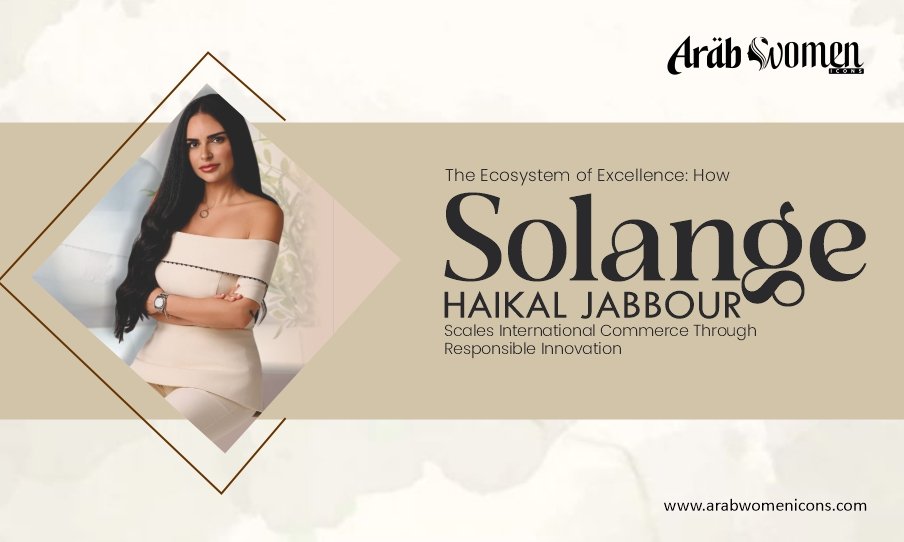
Celebrated widely as one of the Middle East’s women transforming sustainability through innovation, the vision of Solange Haikal Jabbour is the symphony of scale, as she has completely transformed the way diversified corporate ecosystems function on an international scale. Demanding more than capital, global investment, and high-end operations requires a rare capacity to sync vast networks under a single standard of excellence. As economic landscapes change, modern corporate expansion depends heavily on resource efficiency, operational precision, and long-term sustainability. Solange Haikal Jabbour drives this massive operational machine forward with over 20 years of experience in the event industry across the Middle East, GCC, and Europe. Over two decades, she honed her deep expertise in staffing and managing the complex operational aspects of each high-stakes event.
As a seasoned corporate consultant, she successfully created comprehensive training programs, detailed operational manuals, and targeted workshops that contributed directly to the structural success of numerous major international events.
Sol Jabbour’s impact on the events industry has earned her widespread recognition across the Middle East. She was named among Eventex’s 100 Most Influential People in the Events Industry in the Middle East for 2024, a distinction achieved despite being nominated only days before voting closed. Building on this remarkable milestone, she was further recognized as one of the 50 Most Influential People in the Middle East Events Industry for 2025. With over 16 years of experience across the GCC and Europe, Sol has consistently driven business growth, developed high-performing teams, mentored future industry leaders, and elevated standards of excellence throughout the regional events ecosystem.
Today, she successfully scales this operational framework across multiple industries. She is proud to be the Owner and Co-founder of Jabbour Group, which encompasses ten specialized subsidiaries, including Staffing and Hospitality, a law firm, real estate, technical services, Concierge, trading, and holiday homes, among others. She utilizes this diverse corporate portfolio to optimize resource distribution and streamline supply chains across distinct geographical regions.
Her leadership targets global accessibility and seamless execution. With a bold vision to create a comprehensive one-stop shop that offers a wide range of services worldwide, she remains completely dedicated to providing exceptional solutions and experiences to clients across various competitive industries. By embedding structural training systems and high-efficiency operational methods into every tier of her conglomerates, she proves that rapid global growth and sustainable operations can actively thrive together.
Defining Eras of Leadership
The path toward managing an international enterprise required a total commitment to calculated risk and strategic adaptation. The first was making the decision to become an entrepreneur. Leaving the comfort of a stable career to build something from the ground up taught Solange Haikal Jabbour that real growth begins when you’re willing to take risks and trust your own vision. This initial step allowed her to view market challenges as fresh avenues for corporate development.
Her executive reach expanded quickly into new geographic territories, testing her operational models against diverse regulatory systems. The second was expanding into Saudi Arabia and later into Europe. Every market has its own culture, expectations, and way of doing business. That experience taught her that successful leadership isn’t about applying the same formula everywhere. It’s about listening, adapting, and building genuine relationships. This high level of flexibility allowed her firms to integrate smoothly into competitive corporate environments overseas.
True operational durability emerged when economic conditions required steady, clear-headed management. Another defining moment was navigating periods of uncertainty, whether economic shifts, industry challenges, or difficult business decisions. Those moments reinforced that resilience is one of the most important qualities a leader can have. Staying calm, making decisions with confidence, and continuing to move forward, even when the path isn’t clear, has become part of her leadership philosophy. This steady mindset helped stabilize her subsidiaries during complex transition periods.
Her internal drive shifted as she balanced high-level corporate governance with her personal life. Finally, becoming a mother gave me a different perspective on leadership. It strengthened her sense of purpose, taught her the value of balance, and reminded her that success is not only about building businesses but about building a meaningful life. Together, these experiences shaped a philosophy that guides me every day: lead with integrity, embrace change, never stop learning, and have the courage to create opportunities instead of waiting for them.
Building a Synchronized Corporate Network
Solange Haikal Jabbour’s approach to corporate expansion focused on integration rather than simply multiplying assets. Jabbour Group Investments was never about building multiple companies for the sake of diversification. It was about solving real business needs. By focusing strictly on what the market demanded, she built a highly collaborative corporate structure.
Each new enterprise grew directly out of the practical requirements of her expanding international clientele. “As our network grew, so did our clients’ expectations.” A client who came to them for one service often needed support in another, whether it was events, real estate, legal advisory, concierge services, or business consultancy. Rather than sending them elsewhere, she saw an opportunity to create an ecosystem where they could access trusted expertise under one umbrella. This comprehensive structure reduced operational friction for global partners.
Sustaining Value for the Future
The long-term performance of this multi-tiered network relies heavily on keeping operations adaptable and secure. That vision has always been driven by long-term value rather than short-term growth. Every company within the Group has its own identity and expertise, but together they complement one another, creating stronger relationships with their clients and more opportunities for collaboration. This structural interdependence forms the core of her corporate strategy.
By anchoring the conglomerates in resource efficiency, she ensures the entire enterprise can withstand sudden market drops. Sustainability has been a key part of that vision from the beginning. For me, sustainability is about building businesses that remain relevant, adaptable, and resilient. It means investing in strong governance, embracing innovation, nurturing long-term partnerships, and creating businesses that can evolve with changing markets rather than simply react to them. “My goal has never been to build businesses that succeed for today. It has always been to build businesses that continue creating value for years to come.” As global trade patterns continue to shift, she focuses on expanding her interconnected service model into new international hubs.
Redesigning Event Footprints
She actively tackles the heavy environmental impact common in large-scale corporate gatherings by transforming internal operational workflows first. At Fifteen Eleven Events, they believe sustainability begins with the way they operate, not just with the events they deliver. This internal shift ensures that every project starts from a foundation of conservation and efficiency.
To achieve this, she introduced technical systems that removed traditional waste from daily administrative routines. One of the first steps they took was to become a largely paperless business. “Across our offices, we have significantly reduced printed documents by digitizing our internal processes, and through our Fifteen Eleven Events App, our teams manage attendance, check-ins, and check-outs, event information, and reporting electronically, eliminating the need for paper timesheets and manual records.”
Solange Haikal Jabbour’s conservation methodology also changes how physical assets are managed on the ground during major international conventions. “We also encourage responsible resource management across our operations.” Whenever possible, event materials such as signage, branding elements, lanyards, and other reusable assets are collected and repurposed or recycled after an event instead of being discarded. She and her team work closely with their clients and suppliers to reduce unnecessary waste and promote more sustainable event practices without compromising the guest experience. For her, sustainability is not a separate initiative. It is a mindset. It’s about making better decisions every day, embracing technology, reducing waste, and continuously finding smarter ways to operate while delivering the high standards our clients expect.
Innovation as a Growth Driver
Her corporate strategy proves that environmental care can directly boost corporate profits when paired with proper tool development. One of the projects she is proudest of is the development of our Fifteen Eleven Events App. This custom software emerged as a direct response to the friction of managing large, multinational logistics.
The deployment of this digital platform completely restructured how the firm handles field data and workforce deployment. “As our operations expanded across multiple countries and projects involving hundreds of staff, we realized that traditional processes were no longer efficient or sustainable. We wanted to create a solution that would simplify operations while improving the experience for both our clients and our teams. The app digitized many of our day-to-day processes, including staff allocations, attendance, check-ins, check-outs, live updates, and reporting. It significantly reduced our reliance on paper, improved operational accuracy, and gave clients greater visibility into their projects in real time.”
By removing these manual bottlenecks, she unlocked new levels of commercial scalability for the parent enterprise. From a commercial perspective, it enabled them to manage larger and more complex events with greater efficiency, strengthen client confidence, and scale their business without proportionally increasing administrative resources. For Solange Haikal Jabbour, that’s where innovation creates real value. It’s not about adopting technology for the sake of it. It’s about solving a genuine business challenge in a way that improves efficiency, supports sustainability, and creates lasting value for both the business and its clients.
Cultivating Cross-Border Consistency
Managing an investment portfolio across diverse cultural landscapes requires an executive mindset that values core ethics over rigid operational templates. Managing businesses across different countries has taught Solange Haikal Jabbour that consistency doesn’t come from doing everything the same way. It comes from having the same values everywhere you operate.
She applies this flexible philosophy to ensure that every subsidiary respects regional corporate cultures while maintaining world-class delivery metrics. At Jabbour Group Investments, their standards for quality, professionalism, integrity, and client service remain constant. What changes is their approach. Every market has its own culture, regulations, and way of doing business, so they adapt by listening, understanding local needs, and working with the right local partners while maintaining the standards their clients expect.
This delicate balance allows her conglomerates to seamlessly import sustainable practices into emerging global markets. The same applies to sustainability. While practices may differ across markets, our commitment to operating responsibly, embracing innovation, and building businesses with a long-term vision never changes. “For me, successful leadership is about respecting local cultures without compromising the values that define your business.” As the company continues to establish new partnerships across the globe, she focuses on expanding her interconnected service model to meet the evolving demands of the international market.
Harmonizing the Industrial Ecosystem
Solange Haikal Jabbour ensures the corporate stability of her diversified empire by rooting every new expansion in solid human infrastructure. Her husband, who is also her business partner, and she believe that responsible growth starts with having the right people in the right roles. They invest in hiring experienced managers and building strong leadership teams who understand their values and uphold the same standards across every company. This tactical alignment prevents operational friction as assets shift across borders.
By encouraging fluid interaction among independent entities, she maximizes the corporate value of the parent firm. Although each business operates independently, the teams collaborate closely whenever there are opportunities to support one another. “We encourage knowledge sharing, cross referrals, and open communication, allowing each company to benefit from the expertise and network of the others while maintaining its own identity.”
This deep collaborative environment operates alongside a highly structured financial method. “We also grow with discipline. We only expand into sectors where we believe we can add real value and where the new business complements our existing portfolio. This approach has allowed us to create meaningful synergies while maintaining quality, consistency, and sustainable long-term growth.”
A Deeper Definition of Sustainability
Solange Haikal Jabbour’s executive methodology extends conservation beyond natural resources into corporate culture and workforce longevity. She defines sustainability as building a business that can continue to grow without losing its people, its values, or its ability to adapt. This dual focus ensures the corporate structure remains robust through sudden economic shifts.
She builds this institutional strength by treating the workforce as a long-term investment. In terms of people, sustainability means hiring well, developing talent, and creating opportunities for people to grow with the company. In terms of organizational culture, it means building a workplace based on trust, accountability, respect, and consistency, where everyone understands the standards they stand for.
These internal values form the ultimate defense against changing international market conditions. In terms of long-term resilience, sustainability means making decisions that protect the business beyond today. It is about staying adaptable, managing growth responsibly, and building strong foundations that allow the company to survive challenges and continue creating value for the future.
Investing in Human Capital
Her extensive career history confirms that institutional lifespan depends entirely on the structured transfer of operational knowledge. “I believe investing in human capital is the foundation of any business that wants to succeed for decades rather than just a few years.” Businesses don’t grow because of one product or one leader. They grow because of the people behind them.
She observed the consequences of neglecting workforce development firsthand during her earlier corporate career. Early in her career, she helped build businesses as an employee, and she later saw how difficult it was for some of them to continue growing when she left because there hadn’t been enough focus on developing people and transferring knowledge. That reinforced her belief that training and mentoring are not optional. They are essential for long-term success.
To address this industry-wide gap, she established dedicated educational tracks directly within her corporate framework. At Fifteen Eleven Events, they’ve made training a core part of their business. Through Fifteen Eleven Training, they continuously develop their internal teams while also providing training for individuals who want to enter or grow within the events industry. They don’t just recruit people. They invest in helping them build the skills, confidence, and professionalism they need to succeed. “For me, investing in people is one of the most sustainable investments a business can make because when people grow, businesses grow with them.”
The Ultimate Operational Challenge
The true test of Solange Haikal Jabbour’s corporate endurance emerged not from a single crisis, but from the massive effort of scaling an industrial operation to standard. The event industry demands resilience, precision, and rapid decision-making. The biggest challenge wasn’t delivering an event. It was building an operation capable of delivering hundreds of events. As global markets demand larger services, she continues to focus on refining this massive operational machine to handle international workflows smoothly.
Evaluating International Horizons
She manages global expansion by applying a strict, systematic screening process to every potential venture. Before entering any new market or launching a new business, she asks three simple questions: Does it solve a real need? Can we deliver it to the highest standard? Does it align with our values and long-term vision? This corporate discipline prevents the organization from spreading its operational resources too thin.
Her international growth strategy completely avoids impulsive, short-term trends. “We don’t pursue growth for the sake of growth.” Every opportunity is carefully evaluated based on market demand, the right partnerships, operational readiness, and their ability to maintain the quality and reputation we’ve built over the years. By anchoring new ventures in verified local demand, she protects the broader conglomerate from regional market shocks.
Long-term survival requires that the company establish its internal framework well ahead of its marketing campaigns. Scalability is equally important. “We make sure we have the right people, systems, and leadership in place before we expand, so growth is sustainable rather than rushed.” For Solange Haikal Jabbour, success is not measured by how quickly Jabbour Group Investments grows, but by how responsibly it grows while staying true to the values that define the company.
Horizon 2030 and Beyond
Her strategic roadmap looks far past immediate financial quarters to position the conglomerate as a global benchmark of operational integrity. By 2030, she sees Jabbour Group Investments as a globally recognized business group with a stronger international presence, operating across industries while remaining true to the values on which it was built: integrity, quality, innovation, and long-term thinking. This vision guides her current investments in technical infrastructure and talent acquisition.
The ultimate objective focuses on building an elastic business ecosystem that thrives through future shifts in global commerce. “Our goal is to continue expanding strategically, investing in technology, developing exceptional people, and creating businesses that solve real challenges while delivering lasting value to our clients and communities.” She drives this forward by continually upgrading the digital and operational tools used across her seven subsidiaries.
The True Measure of Impact
For her, the ultimate return on investment is the creation of a permanent framework that elevates the entire regional economy. “As a leader, the legacy I hope to leave is not simply a successful group of companies. I want to be remembered for building businesses that create opportunities, empower people to grow, and inspire others to believe that with vision, resilience, and hard work, anything is possible.”
This human-centered purpose remains embedded in every training manual, software deployment, and corporate acquisition she oversees. Her ambition is not simply to build successful companies but to build a legacy of businesses that continue to grow, adapt, and create meaningful impact for generations to come. As the Middle Eastern corporate arena looks to the future, she continues to establish new partnerships across international borders.